 Pelican
What yield percentage means in a kitchen
Almost nothing goes from the delivery to the plate at the weight you paid for. Vegetables are peeled, fish is filleted and skinned, meat is trimmed of fat and sinew, and then roasting, braising or frying takes water out. What is left is the yield. Expressed as a share of the purchased weight it is the yield percentage.
Kitchens use two weights for this. AP weight (as purchased) is what arrives and what is on the invoice. EP weight (edible portion) is what is left after prep and can actually be used. Many kitchens add a third weight after cooking, because a roast or a braise loses a lot more than a carrot.
Yield percentage calculator
Enter the purchased weight, the weight after trimming and, if the item is cooked, the weight after cooking. Add the purchase price per kilo and the quantity you need ready to serve. The calculator gives the total yield, the real cost per usable kilo and how much to order.
The example is the roast beef yield test from the text below. Replace it with your own weights. Yields change with supplier, size, season and the cook, so test again from time to time.
Yield percentage formula
Four formulas cover everything a kitchen needs. All of them start from weights you can take with a kitchen scale.
- Yield percentage EP weight ÷ AP weight × 100. 6.8 kg of trimmed sirloin from 8.0 kg bought is a yield of 85%.
- Cooking yield Cooked weight ÷ raw trimmed weight × 100. 5.1 kg of roast beef from 6.8 kg raw is 75%. Total yield is trim yield × cooking yield, here 0.85 × 0.75 = 0.6375, so 63.75%.
- Cost per usable kilo AP price per kilo ÷ yield. At $22.00 per kilo and a total yield of 63.75%, one kilo of sliced roast beef costs $34.51.
- Quantity to order Quantity needed ÷ yield. For 6.0 kg of cooked roast beef you order 6.0 kg ÷ 0.6375 = 9.41 kg. The inverse of the yield, AP ÷ EP, is the yield factor (1.57 here).
Use the yield as a decimal in these formulas (85% = 0.85). The same yield works in both directions: divide a price by it to get the cost per usable kilo, divide a usable quantity by it to get the order quantity.
Worked example: roast beef for 40 covers
A restaurant serves roast beef at a banquet for 40 guests, 150 g of sliced meat per plate. That is 6.0 kg of cooked meat. Last month the sous chef ran a yield test on the same cut from the same supplier: 8.0 kg of sirloin came in at $22.00 per kilo, $176.00 in total. After trimming fat and silver skin, 6.8 kg was left, a trim loss of 1.2 kg. After roasting and resting, the joint weighed 5.1 kg, another 1.7 kg gone.
Trim yield 85%, cooking yield 75%, total yield 63.75%. To serve 6.0 kg the kitchen orders 6.0 kg ÷ 0.6375 = 9.41 kg of sirloin. At $22.00 per kilo that costs $207.06, or $5.18 of meat per plate.
Had the kitchen ordered the 6.0 kg it wants to serve, it would end up with only 3.8 kg of sliced roast beef, enough for about 25 plates instead of 40. And a recipe card costed at the AP price would show $22.00 per kilo where the real figure is $34.51.
Yield and the real cost per usable kilo
The price on the invoice is the price of the AP weight. What you sell is the EP weight. A whole salmon makes the gap obvious: 6.0 kg at $14.00 per kilo is $84.00. After filleting, pin boning and skinning, the kitchen has 3.9 kg of clean fillet.
Yield 3.9 kg ÷ 6.0 kg = 65%. The fillet costs $14.00 ÷ 0.65 = $21.54 per kilo, not $14.00. This is the number that belongs on the standardized recipe and into the food cost calculation. It is also the fair way to compare suppliers: a cheaper fish with more waste can cost more per usable kilo than a dearer one that is cleaner.
How to run a yield test in six steps
Published yield tables are a starting point at best. Your own test shows what your supplier, your cut and your cooks actually produce. Start with the items where waste costs most: whole fish, primal cuts, shellfish, fresh herbs.
- Weigh the delivery Weigh the item as it arrives, without the box or ice, and note the price per kilo from the invoice. This is the AP weight.
- Prep as usual Trim, peel, bone or fillet it the way your recipe requires, by the cook who normally does it.
- Weigh what is usable Weigh the usable product: this is the EP weight. Weigh any trim you reuse, for example bones for stock, separately.
- Cook and weigh again If the item is cooked, weigh it after cooking and resting, at the point where it is portioned.
- Calculate EP ÷ AP gives the trim yield, cooked ÷ EP the cooking yield, and the product of both the total yield. The calculator above does it for you.
- Write it down where it is used Put the yield on the recipe card and next to the item on your order list, so costing and ordering use the same figure.
Run the test two or three times on different deliveries and use the average. Note the date, the supplier and the cook on the sheet, so the next test can be compared.
Order by yield, not by the recipe weight
Recipes are written in usable weights, orders are placed in purchased weights. The yield is the bridge between the two. A kitchen that orders the recipe weight is short every time an item has trim or cooking loss, and then the team improvises with whatever is left in the walk-in.
Ordering the recipe weight
- 6.0 kg sirloin for 6.0 kg of sliced roast beef
- about 25 plates instead of 40
- last minute top up order or menu change
- recipe cost understated
Ordering by yield
- 9.41 kg sirloin for 6.0 kg cooked
- all 40 plates covered
- one order on the normal delivery day
- cost per plate known in advance
For items you keep in stock, put the yield into the par level: the stock you need is the usable quantity for the period divided by the yield. The guide to par levels shows the rest of that calculation. And check the AP weight when the goods arrive, as described in the receiving log: if the delivery is underweight, no yield calculation will save you.
Common yield mistakes
- Using someone else's table Yields from a book or a supplier depend on their cut, their size and their cooks. Use them only until you have your own figure.
- Forgetting cooking loss A trim yield of 85% looks good. With a cooking yield of 75% on top, only 63.75% of the purchased weight reaches the plate.
- Weighing with ice or packaging Glaze on frozen fish and ice in a fish box belong to neither AP nor EP. Weigh the product only.
- Testing once One test on one delivery can be lucky or unlucky. Two or three tests give a figure you can trust.
- Not updating A new supplier, a different size or a new cook changes the yield. Test again when one of these changes.
Where Pelican helps, and where it does not
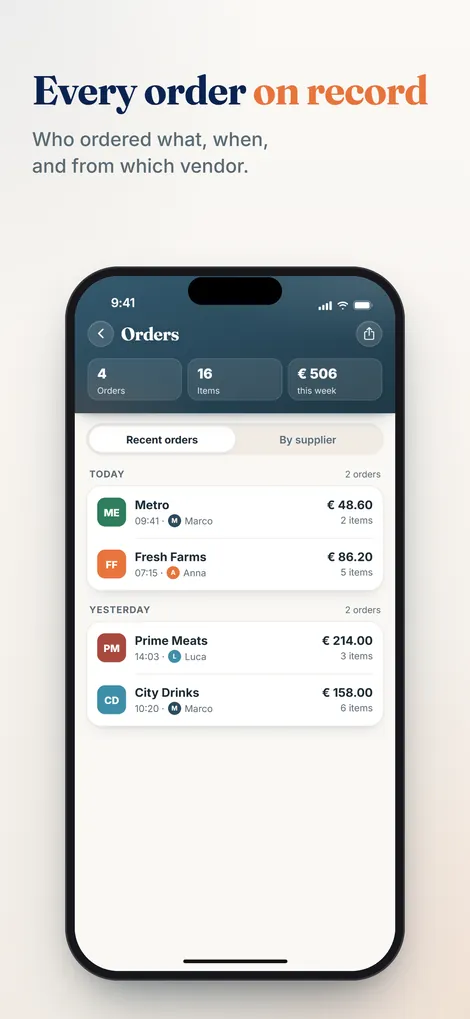
Yield turns a recipe quantity into an order quantity. Pelican is the ordering app for professional kitchens: the whole team adds what is missing to one shared list, by voice or typing, each in their own language, and the head chef approves it before the order goes out. The order history shows what was ordered, when, from which supplier and by whom, and if prices are entered along the way you can see what each kilo actually cost.
What Pelican is not: it does not calculate yields or recipe costs, it does not weigh anything and it does not book stock in and out. It is not a POS, not a guest ordering system and it does not order from your supplier by itself or replace them. You run the yield test and decide the quantity; Pelican makes sure that quantity ends up on the order. Pelican is billed per business, not per user: Solo 19 euros per month (up to 3 users), Basic 29 euros per month (up to 5 users), Pro 59 euros per month (unlimited users). Paid yearly it is 15, 24 or 49 euros per month. Every plan starts with 30 days free.
Frequently asked questions
What is a good yield percentage?
There is no single good figure, because it depends on the product. A carrot loses little, a whole fish or a primal cut loses a lot. The useful comparison is the same item over time and between suppliers: if the yield on your salmon drops from one delivery to the next, something has changed.
What is the difference between yield percentage and yield factor?
Yield percentage is EP ÷ AP, for example 65% for the salmon. The yield factor is the inverse, AP ÷ EP, here 1.54. Both say the same thing: multiply the usable quantity by the factor, or divide it by the yield, to get the quantity to buy.
Do I include cooking loss in the yield?
For anything that is cooked before portioning, yes. Multiply trim yield by cooking yield. For the roast beef in the example that is 0.85 × 0.75 = 0.6375, a total yield of 63.75%.
Can trim that I reuse count as yield?
Only if it really replaces something you would otherwise buy, for example bones for a stock you make anyway. Then give it a fair value and subtract that from the cost. Do not count trim that ends up in the bin or in staff meals.
How often should I run a yield test?
When you add an item to the menu, when you change supplier, cut or size, and otherwise for your most expensive items every few months. Two or three tests on different deliveries give a reliable average.
Order the quantity your yield says
Your team adds what is missing to one shared list, the head chef checks the quantities, and the order history shows what you bought and paid. Try it free for 30 days.
Create business and try 30 days free