 Pelican
Enter purchase prices before tax. Yield = EP weight ÷ AP weight. Everything runs in your browser. Nothing is stored or sent.
What a standardized recipe is, and what it isn't
A standardized recipe is the one version of a dish that everybody on the line cooks the same way. It lists every ingredient with an exact weight per batch, the yield after trimming or cooking, the price you pay and what each line costs. Underneath sit the batch cost, the plate cost per portion and the menu price you need.
This guide is about the cost of one dish. Food cost for the whole restaurant, from beginning inventory, purchases and ending inventory, lives in the food cost calculator guide. The two belong together: the recipe card says what a plate should cost, the monthly food cost says what it really cost.
- Not the chef's notebook A notebook recipe says how to make it. The standardized recipe adds exact weights, the yield of each product and today's prices. Without that, two cooks plate two different dishes at two different costs.
- Not a one time calculation A recipe card is only as good as its prices. When the produce rep raises mushrooms, your plate cost goes up.
- Not just for the bookkeeper It is the chef's tool for portion sizes, menu decisions and for explaining to the owner why a dish costs what it costs.
What goes on a standardized recipe card
A good card fits on one page and always has the same fields:
- Dish name and batch yield For example: mushroom risotto, makes 8 portions. Every number on the card refers to that batch.
- Ingredient and unit One line per ingredient, in the unit you buy it in: kg, liter or each.
- EP weight Edible portion: what actually goes into the dish, trimmed and peeled.
- Yield percentage How much of what you buy you can use. If 1 kg of mushrooms gives 800 g after trimming, the yield is 80 percent.
- AP weight As purchased: what you need to buy to get the EP weight. AP = EP ÷ yield.
- Purchase price and line cost Price per kg or liter before tax, from the latest invoice. Line cost = AP weight × price.
- Method, plating and allergens Short steps, a photo of the plate and the allergens. That turns the costing sheet into the card the line actually cooks from.
Worked example: mushroom risotto, 8 portions
The prices below are examples to show the math, not market prices. For your kitchen only your invoices count.
| Ingredient | EP weight | Yield | Price | Line cost |
|---|---|---|---|---|
| Carnaroli rice | 0.8 kg | 100 % | $4.00/kg | $3.20 |
| Mushrooms | 1.2 kg | 80 % | $6.00/kg | $9.00 |
| Parmesan | 0.2 kg | 100 % | $18.00/kg | $3.60 |
| Butter | 0.15 kg | 100 % | $10.00/kg | $1.50 |
| Onions | 0.3 kg | 90 % | $1.50/kg | $0.50 |
| Vegetable stock (house made, estimated cost) | 3 l | 100 % | $0.40/l | $1.20 |
| White wine | 0.2 l | 100 % | $5.00/l | $1.00 |
| Batch total | $20.00 |
The math: $20.00 divided by 8 portions is $2.50 per plate. If ingredients should be 30 percent of the menu price, divide by 0.30: $2.50 ÷ 0.30 = $8.33 before tax. This is the same example that is loaded in the calculator above, so you can change a price and watch what happens.
AP weight, EP weight and yield
Yield is where most recipe costs go wrong. The risotto needs 1.2 kg of trimmed mushrooms. If trimming loses 20 percent, you have to buy 1.2 ÷ 0.80 = 1.5 kg. You pay for 1.5 kg, not for 1.2.
Cost the edible weight only and the mushroom line comes to $7.20 instead of $9.00: $1.80 short on a single batch. Onions do the same on a smaller scale. Without yield the whole card says $18.15 instead of $20.00, and every plate looks more profitable than it is.
Do not copy yield from a chart, weigh it. Weigh the product as it arrives, prep it the way your crew does and weigh again. Do it three times on different days and use the average. For meat and fish add the cooking loss: weigh raw and cooked and write down both yields.
How to write a standardized recipe in six steps
- Lock the recipe and the batch size. Write the dish the way it actually leaves the pass, not the way it was in the notebook, and decide how many portions the batch makes.
- Weigh every ingredient as EP. On a scale, not by eye. Include garnish, sauce and finishing oil, they cost money too.
- Measure the yield. For everything that gets trimmed, peeled, boned or loses weight in cooking. Whatever goes in whole stays at 100 percent.
- Add today's price. Price before tax from the latest invoice, in the same unit as the weight: per kg if you weigh in kg.
- Cost each line, the batch and the plate. EP ÷ yield × price, add the lines, divide by the portions. Or use the calculator above.
- Test and post it. Check the result against a portion weighed at the pass and post the card where the station can see it, with a photo of the plate.
From plate cost to menu price
The lowest price comes from dividing the plate cost by your food cost target: menu price before tax = plate cost ÷ target. At 30 percent that means multiplying by 3.33. Sales tax or VAT comes on top, depending on where you operate.
Your target is not something to copy from the internet. It comes from your own numbers: sales, labor, rent, energy and the profit you want. The food cost calculator guide shows how to work it out for the whole operation. Keep in mind:
- The lowest price is not the menu price It is the floor. What guests pay also depends on your area, your competition and how you present the dish.
- Not every dish runs the same percentage A vegetable starter can sit below target and a steak above. What counts is the average across what you actually sell.
- Look at the margin in dollars too A dish at 35 percent can leave more money per plate than one at 25 percent. Bills get paid in dollars, not in percentages.
Keeping recipe cards current
A recipe card with last year's prices is worse than none, because it feels safe. The usual mistakes:
- Old prices Update the products that drive the cost whenever the supplier price changes, and every card at least once a season.
- No yield Treating EP weight as if it were what you bought. The mushrooms alone change the result by $1.80.
- The small stuff gets lost Fryer oil, salt, herbs, the bread basket. A miscellaneous line with a fixed amount per portion closes that gap.
- Portions nobody weighs The card says 150 g and the pass sends 180 g. A scale at the pass and a plating photo fix more than any formula.
- A card nobody sees If it only lives on the office computer, the line will not follow it. Print it or post it at the station.
Current recipe cards also make ordering easier: you know what each plate uses and can set your par levels from the portions you sell.
Where Pelican helps, and where it doesn't
To be clear up front: Pelican does not build recipe cards or cost your dishes. It is not recipe management software, it does not track stock with bookings in and out, it is not a POS or a guest ordering app, and it does not replace your supplier or the price talk with the rep.
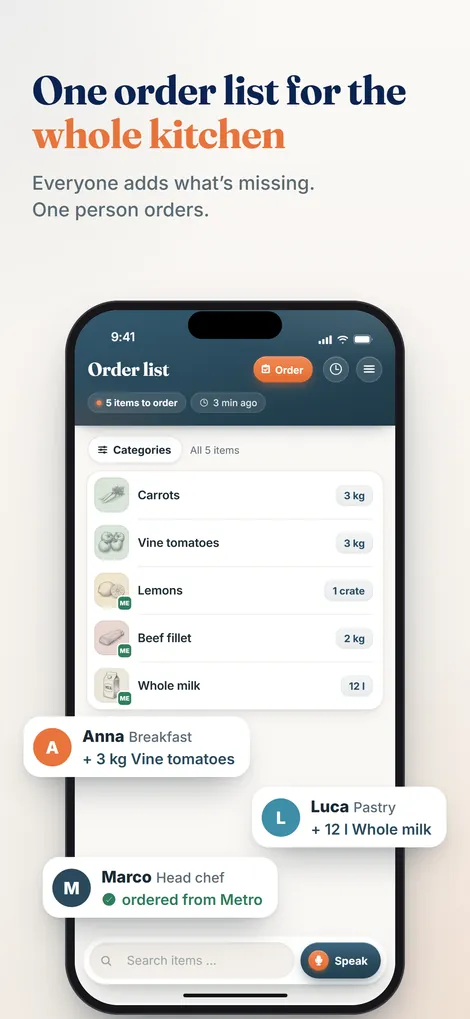
Pelican handles the order. The whole team adds to the same list, by voice or by typing, in English, German or Italian. Pelican recognizes the product, merges duplicates and sorts the list by category. The chef approves it before the rep visit or before it goes out as a PDF or via WhatsApp. In supplier mode you check off what you order and can add the price if you like, for example per kg. That puts the last price you paid at hand when you update a recipe card. The order history shows what was ordered, when, from which supplier and by whom.
Pelican is billed per business, not per user: Solo costs 19 euros per month (up to 3 users), Basic 29 euros per month (up to 5 users), Pro 59 euros per month (unlimited users). Paid yearly it is 15, 24 or 49 euros per month. Every plan starts with 30 days free.
Frequently asked questions about standardized recipes
What is a standardized recipe?
It is the one agreed version of a dish with exact weights per batch, the yield of each ingredient, purchase prices and costs. Added up it gives the recipe cost, and divided by the portions the plate cost.
How do you cost a recipe?
Weigh each ingredient as edible portion, measure its yield, take the purchase price before tax and cost each line as EP weight ÷ yield × price. Add the lines and divide by the number of portions.
What is the difference between AP and EP weight?
AP (as purchased) is what you buy. EP (edible portion) is what is left for the dish after trimming, peeling or cooking. AP = EP ÷ yield. In the example, 1.2 kg of trimmed mushrooms at 80 % yield means buying 1.5 kg.
How do I get a menu price from the plate cost?
Divide the plate cost by your food cost target. At $2.50 per plate and a 30 % target the lowest price is $8.33 before tax. Tax comes on top.
How often should recipe cards be updated?
Whenever the price of a product that drives the cost changes, whenever the recipe or the portion changes, and at least once a season.
Is a recipe costing sheet the same as a standardized recipe?
Almost. The standardized recipe describes the dish: ingredients, method, plating and allergens. The costing sheet adds the money. Many kitchens keep both on one card.
The recipe card says what each plate takes. Pelican turns what is running low into the order.
The whole team calls it into one list, sorted by category and approved by the chef. 30 days free.
Set up your kitchen and try it free for 30 days