 Pelican
Food cost in brief
Food cost percentage, food cost divided by food sales, usually sits between 25 and 35 per cent in hospitality, depending on the concept (or 65 to 75 per cent gross profit, if that is how you look at it). Whether your business is in good shape depends on two things: what gets bought (quantity, price, supplier) and what becomes of it (costing, shrinkage, waste). This guide covers the first half, because that is where the lever lies that you can move immediately without changing systems.
The problem: orders without a memory
In many businesses the kitchen orders on the spur of the moment: the rep comes, the order goes in, the delivery note goes into a folder and the invoice to the bookkeeper. What is missing is the link between them: nobody can say, without digging through files, what was ordered last week, from whom and at what price. The consequences:
- Price increases only show up on the monthly statement, if at all.
- Double orders and "just in case" orders bloat the store, and whatever sits too long ends up in the bin.
- The owner only sees food costs when the accountant does the books, months later, with no chance to correct course.
- When the head chef leaves, all the purchasing knowledge leaves too: usual quantities, good suppliers, negotiated prices.
The order history as the simplest control tool
Before a business invests in inventory management, recipe costing and perpetual stock counts, the much smaller step pays off: record every order: when, what, how much, from whom, by whom and at what price. That alone gives you three controls:
- Price control: the last price is right there at the next meeting. Increases show up immediately and can be raised in the conversation with the rep.
- Quantity control: if twice as much oil as usual is suddenly being ordered, you see it and can ask why before it becomes a habit.
- Spending control: spending per week and per supplier shows trends long before the bookkeeping reports them.
How the history builds up in Pelican, as a by-product
The reason cost control fails in practice is extra work. In Pelican the order history is created as a by-product of normal ordering: the team collects needs on the shared list, the head chef ticks items off with the rep and optionally types in the price. That's all, the history writes itself.
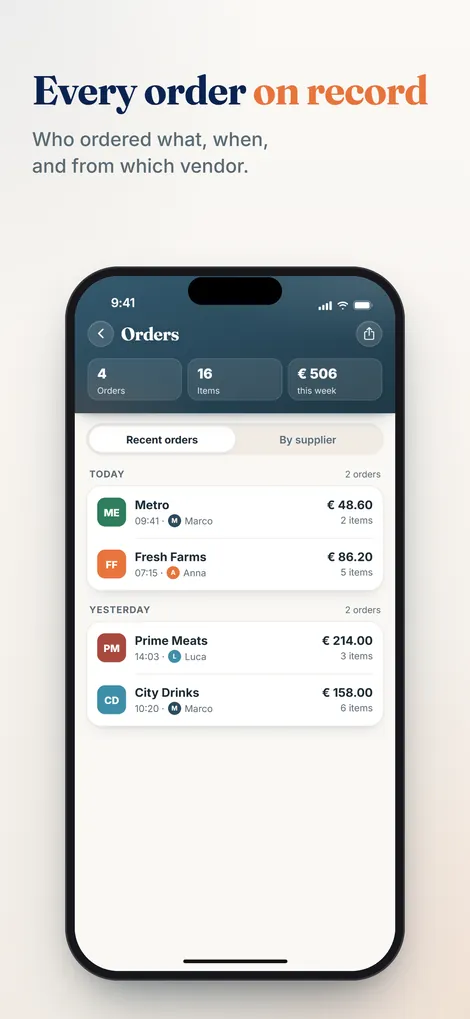
The owner can see at any time what is being ordered in the business, without standing in the kitchen and without having to use the app: payment is by payment link, managed through the customer portal. And a scanner for delivery notes and invoices is in development: take a photo and Pelican automatically checks whether delivery and invoice match the order.
Cost control that happens in the background
Order history, prices and spending per supplier, without Excel and without extra work for the team. Try it free for 30 days.
Create business and try 30 days freePart of the complete guide: Restaurant purchasing. It covers all six stages of the purchasing cycle at a glance.