 Pelican
What a commissary kitchen is
Three restaurants, one menu. Every morning someone in each kitchen starts a veal stock, braises beef and whisks the house dressing. Three cooks do the same job three times, three orders go to the same meat purveyor, and the sauce still tastes a little different in each place. Sooner or later the owner asks: why don't we cook this once for everyone?
That is the idea behind a commissary or central kitchen. One kitchen produces, the others receive finished or part finished components and only finish, reheat or plate. The terms:
- Commissary kitchen In the US the word covers two things: a licensed commercial kitchen that several businesses rent and share, such as food trucks and caterers, and the central kitchen a restaurant group runs for its own locations.
- Central kitchen The kitchen where food is produced for several sites. In hotels, catering and institutional food service it is often called the production kitchen.
- Satellite kitchen The kitchen on site that receives the food. Depending on the model it finishes, reheats, portions or only serves.
- Delivery method How food gets to the site: chilled after cook chill, held hot or frozen. Equipment, transport and shelf life depend on it.
Five commissary kitchen models
Not every commissary is the same. Depending on the business the model looks different:
| Model | Typical for | What happens there | Watch out for |
|---|---|---|---|
| Own commissary for several restaurants | Restaurant groups, chains, bakery cafés | Stocks, sauces, braises, doughs and desserts for every location | fixed order cutoffs and a delivery schedule |
| Production kitchen in a hotel | Hotels with restaurant, banquets, breakfast and room service | Base prep for every outlet in the same building | a clear ordering route between outlets and production |
| Central kitchen with satellite kitchens | Catering, schools, hospitals, corporate dining | Large volumes, often cook chill, service on site | the cold chain and reheating on site |
| Shared rental commissary | Food trucks, caterers, new brands, delivery concepts | Prep by the hour or month in a commercial kitchen that several businesses share | storage space, booking times and sanitation rules in the contract |
| Delivery kitchen without a dining room | Ghost kitchens and virtual brands | Production for delivery only, often for several brands | more in the guide to the ghost kitchen |
For most restaurants and hotels the first two models are the relevant ones. The shared rental commissary is a way in for businesses without their own kitchen, and the central kitchen with satellite kitchens is the standard model in institutional food service.
The model with satellite kitchens is everyday work in cafeterias, schools and hospitals. How production systems, meal counts and purchasing fit together there is covered in the guide to institutional food service.
Central production or prep in every kitchen
Whether a commissary pays off shows when you compare it with what you do today:
Every kitchen preps on its own
- base prep runs in every kitchen in parallel
- every kitchen needs space, equipment and people for prep
- every kitchen orders on its own, often from the same supplier
- taste and portions drift between locations
Commissary kitchen
- base prep runs once for everyone
- locations need less prep space
- purchasing for production is pooled
- same recipe and same quality at every location
In return you take on new jobs: transport, chilling, labels, order cutoffs and a kitchen that has to stay busy. How to prep ahead and cool food fast and safely is covered in the guide to blast chilling and cook chill.
Worked example: three restaurants, one order
An example with sample numbers: three restaurants get their beef stew from the commissary. For Thursday they send in their counts: restaurant A 64 portions, restaurant B 48, restaurant C 28. Each portion gets 6 oz of cooked beef. Braising leaves 70 % of the raw weight. Onions and sauce are left out here.
| Line | Portions | Beef |
|---|---|---|
| Restaurant A | 64 | 24 lb cooked |
| Restaurant B | 48 | 18 lb cooked |
| Restaurant C | 28 | 10.5 lb cooked |
| Total at 6 oz per portion | 140 | 52.5 lb cooked |
| Raw beef at 70 % yield | 140 | 75 lb raw |
| Order in 10 lb cases | 140 | 8 cases, so 80 lb |
The math: portions times portion size gives the cooked weight, divided by the yield gives the raw weight. 140 times 6 oz is 840 oz or 52.5 lb, divided by 0.7 that is 75 lb. If the purveyor packs beef in 10 lb cases, you order 8 cases, so 80 lb. The commissary plans the 5 lb left over into the next braise. How to find your own yield is in the guide to yield percentage, how to set portion sizes in the guide to portion control.
To make this work the commissary needs a fixed rhythm. In the example the restaurants send their counts by 2 pm on Tuesday, the order goes to the purveyor at 4 pm, the beef arrives and is braised on Wednesday, and early Thursday the stew goes out chilled to all three locations. Anyone who sends counts after 2 pm gets their share in the next run.
When a commissary kitchen pays off
A commissary costs space, equipment, transport and organization. These six questions help you decide:
- Do several locations make the same components? The more stocks, sauces, sides and desserts the locations share, the more central production brings.
- Does the product hold well? Braises, soups, stocks, doughs and many desserts hold well chilled. Anything seared, fried or dressed to order belongs on site.
- Are the site kitchens short on space? Where the kitchen is small, the commissary frees up room for service.
- Are good cooks hard to find? In the commissary a settled team does the base prep. On site a smaller crew is often enough to finish and plate.
- Can you handle transport? Short distances, a refrigerated van or insulated carriers and a fixed delivery schedule. Without them food does not arrive safely.
- Is there enough volume? The commissary has to be busy. With two small locations it is often simpler for one kitchen to prep for the other.
Purchasing and ordering in two steps
A commissary changes purchasing. There are now two ordering routes:
- Step 1: locations order from the commissary Every location sends its needs for components by the cutoff, ideally from a fixed list with item, unit and quantity. That tells the commissary what to produce.
- Step 2: the commissary orders from suppliers From the total of all locations and the yield the commissary works out the raw product. Because the volumes are larger, you can talk pack sizes, delivery days and prices with your suppliers.
- What locations still order themselves Fresh product for service, bread, drinks and anything not made centrally is still ordered directly by each location. Decide what goes through which route.
- Par levels in the commissary Base ingredients such as flour, oil, canned goods and spices deserve fixed par levels. That way not every production run needs its own order.
Food safety, transport and records
Once food leaves the kitchen, records matter more. Four points belong in every plan:
- Chill and transport Prepped food is cooled fast and transported cold, hot food stays hot. Which targets apply and how to check them is in the guide to the temperature danger zone.
- A label on every container Product, production date, use by date and batch. What a good kitchen label looks like is in the guide to day dots and food labels.
- Traceability Write down which batch went to which location. If there is a problem, you know right away where the food is.
- Allergens The allergen information travels with the product, so service on site can answer guests correctly. More in the guide to the 14 allergens.
If a kitchen supplies other businesses, it may need its own registration, permit or approval from the food safety authority, depending on the country or state, the product and the volume, especially for food of animal origin. Check with your local health department or food authority before you sign a lease or build, and add the commissary to your HACCP plan.
How to set up a commissary kitchen: six steps
This is how you get from the idea to a running production without switching every location at once.
- Pick the components. List what every location makes the same way and choose two or three products that hold well.
- Standardize the recipes. Every component gets a standardized recipe with quantities, yield and portion size that applies to every location.
- Set delivery method and transport. Chilled, hot or frozen, in which containers, with which vehicle and how often a week. Containers in hotel pan sizes fit refrigeration and combi ovens at every location.
- Order cutoff and delivery schedule. Decide when locations send their counts, when the commissary orders from suppliers and when food goes out.
- An item list for the locations. A fixed list of items, units and pack sizes that locations order from, with the same names everywhere.
- Test and adjust. Start with one location or a few products, check quantities, leftovers and quality after two weeks and then expand.
Common mistakes
- Centralizing everything at once Moving half the menu on day one means too many new routines at the same time.
- No order cutoff Locations call in whenever, and the commissary produces by guesswork.
- Different item names Every location calls the sauce something else, so the quantities cannot be added up.
- Transport not planned The food is ready, but nobody drives, or it arrives warm.
- No labels On site nobody knows when the stock was made or when it has to be used.
- Asking the authority too late Finding out after the build that the commissary needs a permit or approval can mean paying twice.
Where Pelican helps and where it does not
Pelican helps with purchasing, not with production. In the commissary the team adds what the next production run is missing to the shared order list by voice or by typing, each person in their own language. Pelican recognizes the product, merges duplicates and sorts the list by category. The chef approves it before the rep visits, and in supplier mode items are checked off with the rep. In the order history you see later what was ordered from which supplier and when.
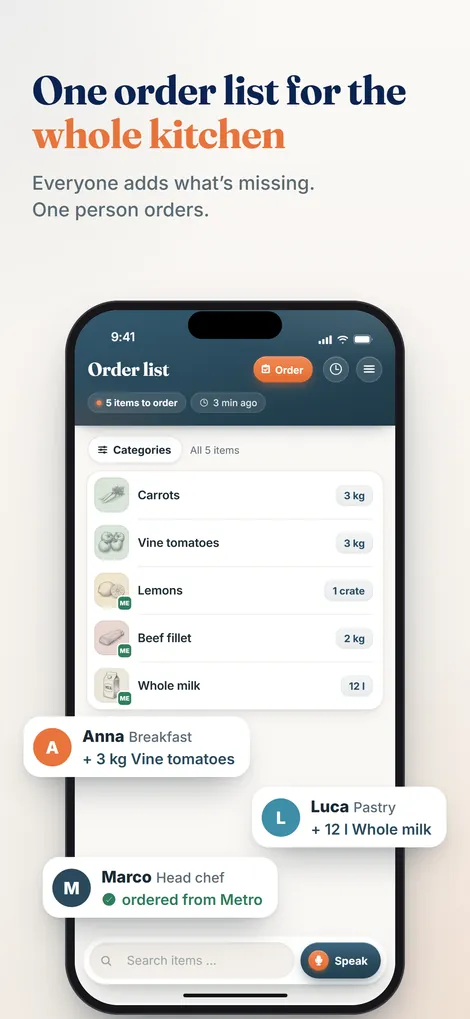
Pelican is not a POS, not a guest ordering system and not inventory accounting, and it does not place orders with your suppliers. You order the way you always do, with the rep, by phone or at the cash and carry. Pelican does not plan production, does not cost recipes and is not a system for delivery notes or transfers between locations.
Frequently asked questions
What is a commissary kitchen?
A commissary kitchen is a commercial kitchen where food is prepared for more than one place. In the US it often means a licensed kitchen that food trucks, caterers and other businesses rent and share. Restaurant groups also use the word for the central kitchen that preps for their own locations.
What is the difference between a central kitchen and a satellite kitchen?
The central kitchen produces, the satellite kitchen on site receives the food. Depending on the model the satellite kitchen finishes, reheats chilled food, portions or only serves. How much happens on site you decide product by product.
Is a commissary kitchen the same as a ghost kitchen?
Not quite. A ghost kitchen cooks finished meals for delivery to guests. A commissary preps food or components for other kitchens, food trucks or caterers. Some ghost kitchens run in shared commissary spaces, which is why the terms get mixed up.
When does a commissary kitchen pay off?
When several locations make many of the same components that hold well, the site kitchens are tight and transport is short and predictable. With two small locations it is often enough for one kitchen to prep for the other.
How does a commissary work out its order?
It adds up the counts from the locations, uses the portion size to get the cooked weight and divides by the yield. In the example 140 portions of 6 oz are 52.5 lb of cooked beef, at 70 % yield 75 lb raw. In 10 lb cases that is 8 cases.
Does a commissary kitchen need a permit?
That depends on the country or state, the product and the volume. A kitchen that supplies other businesses may need its own registration, permit or approval from the food safety authority, especially for food of animal origin. Ask your local health department before you sign a lease or build.
One order for the whole production
Pelican collects what your commissary team is missing in one order list, in every language in your kitchen. The order history shows what was ordered from whom. Try it free for 30 days. The cooking stays in your kitchen.
Create business and try 30 days free