 Pelican
What gastronorm means
The sous chef slides a sheet into the combi oven, the cold station drops three pans of salad into the prep table, and tonight's mise en place is stacked in the walk-in. It all fits because it all shares one footprint. Gastronorm, or GN, is that sizing system for pans, trays and racks in professional kitchens.
The dimensions are set in the European standard EN 631-1 for catering containers. It describes a modular system so that pans from different makers can replace each other. In daily kitchen terms:
- One base size GN 1/1 measures 530 × 325 mm outside. Every other size is derived from it.
- Fractions and multiples GN 1/2 takes half the area, GN 1/3 a third, GN 2/1 twice as much. The fraction tells you how much of one full size slot a pan uses.
- Outside dimensions are fixed What counts is the outside at the rim: length and width. Inside dimensions, wall thickness and therefore capacity vary by maker.
- Interchangeable A GN 1/3 pan from one maker fits the same opening as one from another. You can reorder without changing your equipment.
Gastronorm sizes: every dimension in one chart
The nine common gastronorm sizes with their outside dimensions. Inches are converted from millimeters and rounded. The last column shows how many pans of that size fill one full size (1/1) slot.
| GN size | Outside (mm) | Outside (in, approx.) | Fill one 1/1 slot |
|---|---|---|---|
| GN 2/1 | 650 × 530 | 25.6 × 20.9 | takes two 1/1 slots |
| GN 1/1 | 530 × 325 | 20.9 × 12.8 | 1 pan |
| GN 2/3 | 354 × 325 | 13.9 × 12.8 | 1 pan plus 1 × GN 1/3 |
| GN 1/2 | 325 × 265 | 12.8 × 10.4 | 2 pans |
| GN 2/4 | 530 × 162 | 20.9 × 6.4 | 2 pans |
| GN 1/3 | 325 × 176 | 12.8 × 6.9 | 3 pans |
| GN 1/4 | 265 × 162 | 10.4 × 6.4 | 4 pans |
| GN 1/6 | 176 × 162 | 6.9 × 6.4 | 6 pans |
| GN 1/9 | 176 × 108 | 6.9 × 4.3 | 9 pans |
Depths and capacity: how much each pan holds
The depth follows the size: a GN 1/1 65 is a full size pan 65 mm deep. Common depths are 20, 40, 65, 100, 150 and 200 mm, plus in between depths such as 55 mm. Shallow pans of 20 or 40 mm are used more for baking, grilling and plating, deep ones for sides, sauces and stock in the walk-in.
How much fits depends on inside dimensions and wall thickness, so on the maker. The chart shows guide values from one maker's catalog for stainless steel pans, in liters with US quarts converted (1 liter is about 1.06 quarts).
| GN size | 65 mm (2½ in) | 100 mm (4 in) | 150 mm (6 in) | 200 mm (about 8 in) |
|---|---|---|---|---|
| GN 2/1 | 19 l / 20.1 qt | 30 l / 31.7 qt | 43 l / 45.4 qt | 58 l / 61.3 qt |
| GN 1/1 | 9 l / 9.5 qt | 14 l / 14.8 qt | 21 l / 22.2 qt | 28 l / 29.6 qt |
| GN 2/3 | 5.5 l / 5.8 qt | 9 l / 9.5 qt | 13 l / 13.7 qt | 18 l / 19.0 qt |
| GN 1/2 | 4 l / 4.2 qt | 6.5 l / 6.9 qt | 9.5 l / 10.0 qt | 12.5 l / 13.2 qt |
| GN 2/4 | 4 l / 4.2 qt | 5.8 l / 6.1 qt | 8.6 l / 9.1 qt | not common |
| GN 1/3 | 2.5 l / 2.6 qt | 4 l / 4.2 qt | 5.7 l / 6.0 qt | 7.8 l / 8.2 qt |
| GN 1/4 | 1.8 l / 1.9 qt | 2.8 l / 3.0 qt | 4 l / 4.2 qt | 5.5 l / 5.8 qt |
| GN 1/6 | 1 l / 1.1 qt | 1.6 l / 1.7 qt | 2.4 l / 2.5 qt | 3.4 l / 3.6 qt |
| GN 1/9 | 0.6 l / 0.6 qt | 1 l / 1.1 qt | not common | not common |
Other makers often list a little less, for example 8.5 instead of 9 liters for a GN 1/1 at 65 mm, because they measure only to just below the rim. For shallow pans: the same maker lists a GN 1/1 at 40 mm at about 5 liters and at 20 mm at about 2.5 liters.
Gastronorm vs US hotel pans: what is standard and what is not
The standard makes sure pans fit openings, frames and shelves. Wall thickness, corner radius and the shape of the rim are up to each maker. That is why two pans of the same size can hold different amounts.
Set by the standard
- Outside dimensions at the rim
- Base size 530 × 325 mm
- Fractions such as 1/2, 1/3, 1/9
- Interchangeable in openings
Up to the maker
- Inside dimensions at the bottom
- Capacity in liters or quarts
- Wall thickness and material
- Lids, handles and rim
US hotel pans, also called steam table pans or food pans, are sized in inches. The same fractions are called full size, two thirds, half, third, fourth, sixth and ninth size. A full size pan is nominally called 12 × 20 inches. One US maker lists its full size pan at 12.78 × 20.84 inches outside, about 325 × 529 mm, and rates its 6 inch deep version at up to 21 quarts brimful. Common US depths are 2½, 4 and 6 inches, with shallower and deeper pans available. That is close to GN 1/1, but US pans are built to inch dimensions, not to EN 631. If you mix US pans with GN equipment or lids, test the fit first.
Combining pans: which sizes fill one full size slot
Prep tables, refrigerated counters and steam tables often take pans in full size openings. Adapter bars split one slot into smaller pans. These combinations work because the outside dimensions add up exactly:
- 2 × GN 1/2 Two pans of 325 × 265 mm make 325 × 530 mm. A classic for two sides on the pass.
- 3 × GN 1/3 Three pans of 325 × 176 mm fill the slot. A typical setup on a sandwich or salad prep table.
- GN 2/3 and GN 1/3 One large and one small pan, for example salad and dressing.
- GN 1/2 and 2 × GN 1/4 One half large, the other half split into two fourths.
- 6 × GN 1/6 or 9 × GN 1/9 Many small components, such as toppings, herbs or garnishes.
- GN 1/3, 2 × GN 1/6 and 3 × GN 1/9 Three sizes in one slot when a station needs many different amounts.
Worked example: planning pans for a prep table
An example: your prep table takes 2 × GN 1/1, and the cold station needs three salads and six toppings. You split the first slot into 3 × GN 1/3 and the second into 6 × GN 1/6, all 100 mm (4 in) deep. The numbers are an example, the liters are guide values from the chart above.
The math: 3 × GN 1/3 at 4 liters each is 12 liters, 6 × GN 1/6 at 1.6 liters each is 9.6 liters, 21.6 liters in total, about 22.8 quarts. For swapping during service you need each pan twice: 6 × GN 1/3 and 12 × GN 1/6, so 18 pans, plus matching lids. While one set sits in the prep table, the other gets refilled in the walk-in.
Where gastronorm pans fit
Gastronorm is more than a pan. A lot of commercial kitchen equipment is built to the same dimensions. Typical places:
- Combi ovens and convection ovens A combi oven listed as 10 × GN 1/1 has shelf positions for ten full size pans, sheets or racks. Larger units take GN 2/1.
- Reach-in refrigerators and freezers Commercial refrigerators and freezers are available with gastronorm slides, so pans and racks go straight in.
- Prep tables and refrigerated counters Pan openings on top, refrigerated storage below. The pan layout decides how far the cook has to reach.
- Steam tables and hot holding Sides and sauces sit in gastronorm pans in the water bath or the hot holding counter.
- Chafing dishes and buffets For display, gastronorm pans also come in porcelain or glass.
- Transport and storage Stackable with lids, for the way from the walk-in to the station or in insulated carriers for catering.
Hotel pans in mise en place, storage and ordering
When everything shares the same dimensions, order gets easier. A walk-in shelf laid out for full size pans takes any pan. Fixed spots and clear labels keep the store readable, as described in the guide to restaurant stock management. Every pan that goes into the walk-in gets a label with contents and date. What belongs on it is in the guide to day dots and food labels.
For mise en place the pan is often the unit: at the end of service the station sees at once whether half a pan or no pan of onions is left. That look is the moment to reorder. And whoever notices during breakdown that lids, film or labels are running low should say so right away, not when they are gone.
Shallow pans in one standard size also win when cooling: they chill faster and go straight from blast chiller to combi oven. How that fits the workflow is in the guide to blast chilling and cook chill.
How to plan hotel pans for your kitchen: six steps
New kitchen or replacing dented pans: follow this order and you only buy what you need.
- List your equipment. Write down for each unit which gastronorm size it takes and how many shelf positions or openings it has: combi ovens, refrigerators, prep tables, steam tables, shelving. How to arrange the equipment is covered in the guide to commercial kitchen layout.
- Walk through each station. For each station: which components sit there, and how much of each does one service need? That gives you the layout, for example 3 × GN 1/3 and 6 × GN 1/6.
- Choose depth by contents. Shallow for baking and plating, 65 or 100 mm for most components, deep for sauces, stocks and backup. The capacity chart above helps you estimate.
- Plan a second set. For every component in service one more pan for refilling, plus spares for the walk-in and the dish machine.
- Add lids, bars and labels. A lid for every pan that gets stored. Adapter bars for every split of a full size slot. Labels for contents and date.
- Set the material by use. Stainless steel for heat, plastic for storage, perforated for steaming. Check temperature range and dishwasher suitability with the maker.
Common hotel pan mistakes
- Measuring the inside Measure the outside at the rim. Measuring the inside at the bottom gives you a size that does not exist.
- Swapping length and width 530 × 325 and 325 × 530 are the same pan. Order by the GN size, not only by the numbers.
- Lids from anywhere Rim and inside dimensions are not standardized. Test lids and inserts from another maker first.
- Filled to the brim A brimful pan spills when carried and no longer takes a lid. Plan with headroom.
- Plastic in the oven Not every plastic handles heat. What can go into the combi oven is stated by the maker.
- Too few small pans Sixth and ninth pans in particular disappear into the dish machine and the walk-in. With only one set, you run out during service.
Where Pelican helps and where it does not
Pelican does not plan your hotel pans and does not keep an inventory of your kitchen. It helps at a different point: whoever sees at the station that the last pan of onions is open, or that film and labels are running low, adds it to the shared order list by voice or typing, in their own language. The head chef releases the list, and the order history later shows when what was ordered from which supplier.
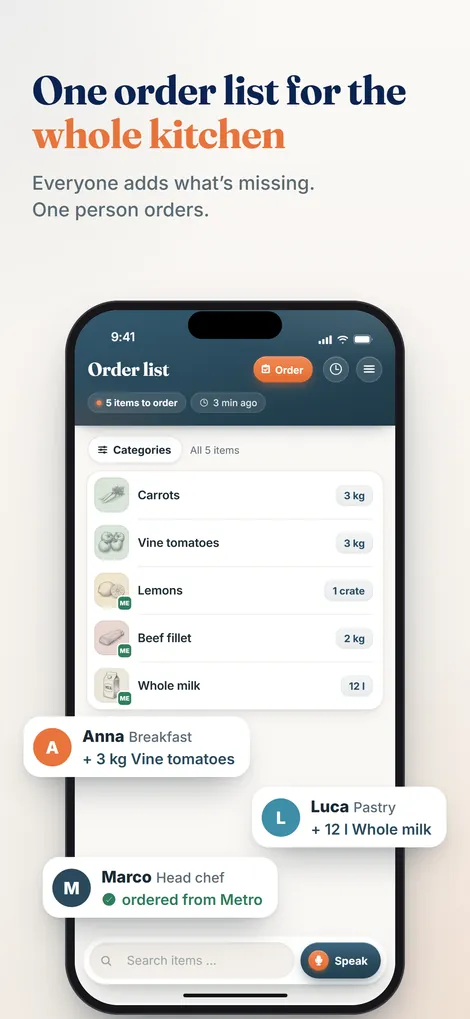
Pelican is not a POS system, not a guest ordering system and not stock accounting, and it does not place orders with suppliers itself. You still order the usual way, with the rep, on the phone or at the cash and carry.
Pelican is billed per business, not per user: Solo 19 euros per month (up to 3 users), Basic 29 euros per month (up to 5 users), Pro 59 euros per month (unlimited users). Paid yearly it is 15, 24 or 49 euros per month. Every plan starts with 30 days free.
Frequently asked questions
What size is a full size hotel pan?
A gastronorm full size pan (GN 1/1) measures 530 × 325 mm outside, about 20.9 × 12.8 inches. A US full size pan is nominally called 12 × 20 inches. One US maker lists its full size pan at 12.78 × 20.84 inches outside. Depths are chosen by use.
How many quarts does a full size hotel pan hold?
It depends on depth and maker. Guide values from one maker's catalog for GN 1/1: 65 mm about 9 liters (9.5 quarts), 100 mm about 14 liters (14.8 quarts), 150 mm about 21 liters (22.2 quarts), 200 mm about 28 liters (29.6 quarts). Others often list a little less.
What is a GN 1/3 pan?
A GN 1/3 pan takes a third of a full size slot and measures 325 × 176 mm outside, about 12.8 × 6.9 inches. Three of them fill exactly one full size slot, for example in a prep table.
Do gastronorm pans from different makers fit together?
In openings and frames, yes, because EN 631 fixes the outside dimensions. Inside dimensions, rims and lids can differ. Test lids and inserts from another maker before you buy in quantity.
Are US hotel pans the same as gastronorm?
No. US hotel pans are sized in inches and not built to EN 631. A full size pan is close to GN 1/1 in size, but if you mix both systems, check the fit of pans, lids and inserts first.
Which depth should I use for what?
Shallow pans of 20 or 40 mm for baking, grilling and plating. 65 and 100 mm (2½ and 4 inches) suit most components on the line. 150 and 200 mm for sauces, stocks and backup in the walk-in.
What the station runs out of goes straight on the list
Pelican collects what your team is missing in one order list, in every language of your kitchen. Try it free for 30 days. It does not count your hotel pans.
Create business and try 30 days free