 Pelican
Why every opened product needs a label
In the walk-in, one container of veal stock looks like the next. Whether it is from yesterday or last week, only the cook who made it knows, and that cook is off today. A label takes the question out of someone's head and puts it on the container. Four things depend on it:
- Safety Food that is kept too long can make people sick even when it still looks and smells fine. The date decides, not your nose.
- Rotation You can only use the oldest product first if you can see which one is oldest. That is FIFO, and it does not work without a date.
- Traceability If there is a recall or a complaint, you need to say which supplier a product came from.
- Less waste When you see early what is about to expire, you can work it into the prep list or the special instead of throwing it out on Friday.
What goes on a kitchen food label
A label has to be quick to write and quick to read, or nobody writes it during service. These six fields cover most kitchens. The first four always go on.
| Field | Example | Why |
|---|---|---|
| Product | Veal stock, ground beef, house vinaigrette | Many things look the same in a container |
| Made or opened on | Tue 11/10 | The shelf life starts here |
| Use by | Thu 11/12 | The most important field, write it large |
| Initials | MK | Whoever made it can answer questions |
| Allergens | Celery, mustard | For guest questions and front of house |
| Supplier or lot | For meat, fish, eggs | In case of a recall |
Use by, best before and your own date
Bought products carry two different kinds of date, and they do not mean the same thing. In the UK, the rules taken over from EU law (Regulation 1169/2011) keep them clearly apart, and the government guidance on food labelling explains both:
Best before
- About quality
- Until then the product keeps its properties if stored correctly
- On pasta, canned goods, hard cheese, spices
- After it, check the product, do not throw it out automatically
Use by
- About safety
- On highly perishable food
- On ground meat, fresh poultry, fresh fish
- After it, the food is treated as unsafe and goes in the bin
As soon as you open a pack, portion it or make something yourself, you need a third date: your own. If the pack says "once opened, use within x days", that clock starts when you open it, and the label carries the opening date. For everything you make in house, you set the shelf life in your HACCP plan, based on the manufacturer, local guidance and your own experience. In the US, the FDA Food Code adds a hard limit for some foods, see below.
Worked example: the use by date
An example with a house rule like many kitchens use for food made in house and kept in the walk-in: 3 days, with the day of preparation counted as day 1. The 3 days are not a legal value but a rule the business sets for itself. The veal stock is made and cooled on Tuesday.
Tuesday is day 1, Wednesday day 2, Thursday day 3. So the label says "use by Thu", not "3 days". If staff have to count, they count wrong during service. The most common mistake is not counting the day of preparation: then the label says Friday and the stock gets one more day than your rule allows.
FIFO and FEFO: the order in the walk-in
FIFO means first in, first out: what arrived first goes out first. FEFO means first expired, first out: what expires first goes out first. Usually that is the same thing. When it is not, the date wins. A new delivery of yogurt with an earlier date than the stock on the shelf gets used first.
- New stock to the back When putting away, the fresh delivery goes behind or below what is already there, never in front.
- Opened items to the front Open packs and leftovers sit at the front and on top so they get picked first.
- One spot per product If cream lives in three places, three packs get opened at the same time.
- Label facing out Place containers so the date is readable without lifting them.
- Daily check Once a day, for example before the delivery, someone walks through the walk-in and the lowboys and pulls whatever has expired.
- Out means out Expired food goes straight in the bin or into a clearly marked separate box, not "to the back for now".
What the rules say about date marking and traceability
The rules differ by country. This is a summary for the US and the UK, not legal advice.
- US: date marking Section 3-501.17 of the FDA Food Code says that ready-to-eat, time/temperature control for safety food prepared on site and held refrigerated for more than 24 hours must be marked with a date. At 41 °F (5 °C) or below it may be kept for up to 7 days, and the day of preparation counts as day 1. Section 3-501.18 says it must be discarded after that.
- US: your state Each state adopts the Food Code on its own, sometimes with changes. Your local health department tells you which version and which rules apply to you.
- UK: traceability and dates The rules taken over from EU law still apply: under Article 18 of Regulation 178/2002 you must be able to say who supplied a food to you and which businesses you supplied. Guests are not meant by that. Use by is about safety, best before about quality. Your contact is the Environmental Health Officer at your local authority.
Set up a labeling system in six steps
A labeling system rarely fails because of the material. It fails because only some people use it. This order helps it stick.
- Set the rule. What gets a label? The simplest rule: everything that is no longer in its sealed original packaging. No exceptions for "just for a minute".
- Write down shelf lives. A list of house shelf lives for what you make often: stocks, sauces, dressings, marinated meat, cut vegetables. The list belongs in your HACCP plan and on the wall of the walk-in.
- Put material everywhere. Labels or masking tape and permanent markers at every station and at the walk-in. If people have to search, they skip it.
- Make the format the same. Everyone writes the fields in the same order and the date in the same format, with the day of the week.
- FIFO when putting away. Whoever puts a delivery away places it behind the existing stock. This also applies after the receiving check and for frozen goods.
- Check every day. One person walks through the walk-in and the lowboys at a fixed time every day, pulls expired food and looks at what expires soon.
Masking tape, day dots or a label printer
Which material you use matters less than having it everywhere, making sure it sticks in cold and damp conditions, and making sure it comes off cleanly so old labels do not stay on the containers.
Masking tape and marker
- Costs almost nothing, available everywhere
- Anyone can start right away
- Handwriting has to be readable
- Often hard to peel off containers
Day dots or printed labels
- Fixed fields, everyone writes the same way
- Color coded day dots show the day at a glance
- Dissolvable versions wash off in the dish machine
- Cost money and need restocking
Labels, waste and the next order
Labels do not only show what has to go, they also show why. If cream expires every week, that is not a labeling problem but an order quantity that does not fit. During the daily check, note what was thrown out. After two or three weeks you see which par level is too high.
Traceability starts at receiving: the delivery note and the invoice are your record of who supplied a product. And whoever uses the last of something is the first to notice it is missing. That moment is the right one to note it for the next order.
Common food labeling mistakes
- Only the prep date Then everyone has to work out how long it keeps. The use by date always goes on.
- Label on the lid Lids move around. The label goes on the container.
- Labeling over an old label Two dates on one container are worse than none. Take the old label off before refilling.
- Combining leftovers Tipping yesterday's batch onto today's turns two dates into one wrong one.
- New stock in front Easier when putting away, but then the old stock expires at the back.
- Mixing up use by and best before Throwing out pasta past best before but using ground beef past use by is exactly the wrong way round.
Where Pelican helps and where it does not
Pelican does not print labels and does not calculate shelf life. It helps with the step after: whoever notices during the check that something has to go or will run out soon adds it to the shared order list by voice or typing, in their own language. The head chef then approves one list.
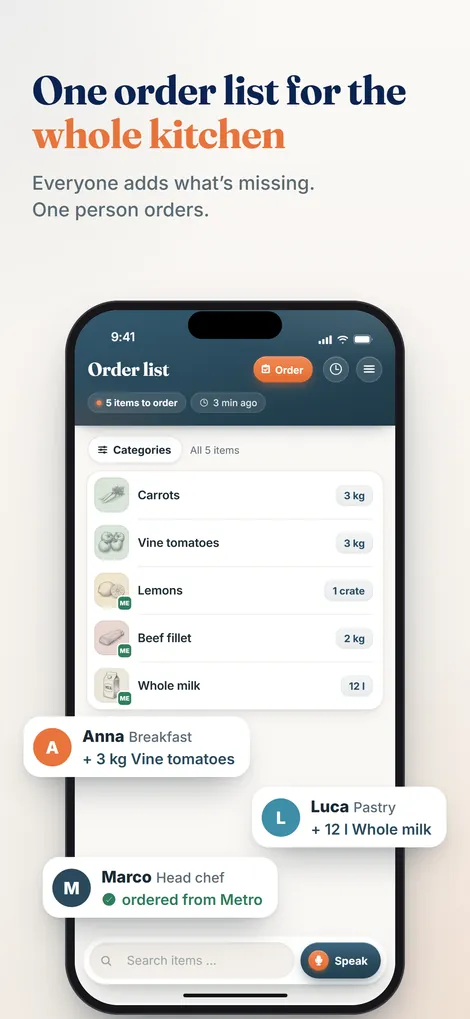
Pelican is not a label printer and not a food safety tool. It does not track traceability, temperature logs or shelf lives. Pelican is also not a POS, not a guest ordering app and not an inventory system with stock bookings, and it does not place orders with the supplier itself.
Pelican is billed per business, not per user: Solo 19 euros per month (up to 3 users), Basic 29 euros per month (up to 5 users), Pro 59 euros per month (unlimited users). Paid yearly it is 15, 24 or 49 euros per month. Every plan starts with 30 days free.
Frequently asked questions
What are day dots?
Day dots are small color coded labels, one color per day of the week, often with space to write the product and the use by date. They show at a glance which day a container belongs to. Some versions dissolve in the dish machine so they do not stick to the containers.
What should a food label in a kitchen include?
At least the product, the date it was made or opened, the use by date and the initials of whoever made it. Allergens help on sauces and fillings, and the supplier or lot on meat, fish and eggs.
How long can food be kept after date marking?
Under section 3-501.17 of the FDA Food Code, ready-to-eat, time/temperature control for safety food held at 41 °F (5 °C) or below may be kept for up to 7 days, with the day of preparation as day 1. Many kitchens set shorter house rules for some foods. Check which version your state uses.
Does the day of preparation count as day 1?
Under the FDA Food Code it does. For your own house rule, decide once and make sure everyone counts the same way. With a 3 day rule, stock made on Tuesday is used by Thursday.
What is the difference between FIFO and FEFO?
FIFO uses first what arrived first. FEFO uses first what expires first. Usually they match; when they do not, the date wins.
Do I need to keep delivery notes?
To trace a product you need to show who supplied it, and delivery notes and invoices are the simplest record. How long to keep them depends on your local rules and your accountant.
What runs out goes straight on the list
Pelican collects what your team notices is missing during the walk-in check in one order list, in every language of your kitchen. Try it free for 30 days. It does not print your labels.
Create business and try 30 days free