 Pelican
What HACCP means in a restaurant kitchen
HACCP stands for Hazard Analysis and Critical Control Points. It is a way of thinking about food safety: instead of finding out after service that something went wrong, you decide in advance where things can go wrong and how you will notice in time.
In a kitchen the hazards are familiar. Bacteria survive in undercooked chicken or grow in a stock that cools too slowly. Allergens get into the wrong dish. A piece of broken glass ends up in the mise en place. HACCP sorts these into biological, chemical and physical hazards and asks one question for each: at which step can we still catch this?
That step is the critical control point, or CCP. A probe thermometer in the thickest part of a chicken breast is a CCP. A clean cutting board is important, but it is hygiene basics and not a CCP, because you cannot measure it and hold a line against it during service.
Does your restaurant legally need a HACCP plan?
It depends on where you are, and the answer differs more than most templates admit.
- United States The FDA Food Code 2022 is a model that states adopt with their own changes. It requires a HACCP plan submitted to the regulator when a variance is needed (section 3-502.11) or for reduced oxygen packaging without one (3-502.12, 8-201.13). That covers smoking or curing to preserve food, using additives or vinegar to preserve it, such as acidified sushi rice, vacuum packing and sous vide, and shellfish display tanks. A restaurant that does none of this usually has no formal plan requirement, but the regulator still expects you to control the risks.
- United Kingdom GOV.UK says any food business needs a food safety management system that meets the HACCP principles. Small caterers often use the free Safer Food, Better Business pack from the Food Standards Agency.
- European Union Regulation (EC) No 852/2004, Article 5, requires procedures based on HACCP principles from every food business after primary production. Recital 15 asks for flexibility, including for small businesses.
Hygiene basics come first
HACCP sits on top of everyday good practice, which the FDA calls prerequisite programs. If these are missing, no plan will save you. Most of what happens in a restaurant kitchen is controlled here and not at a CCP.
- Personal hygiene Handwashing, clean uniforms, and a clear rule for who stays home when sick.
- Cleaning A written schedule that says what, how often, with what, and who signs.
- Pest control Regular checks, sealed dry storage and a record of what was done.
- Suppliers and receiving Approved suppliers and a receiving check with a log at the back door.
- Storage FIFO, labeled and dated products, raw below cooked in the walk-in.
- Allergens Know what is in every dish, and keep it in the written recipes.
- Training New staff learn the rules in a language they understand, before they work a station.
The 7 HACCP principles in kitchen language
The seven principles are the same in the Codex Alimentarius, at the FDA and in EU law. Before you start, pick who owns the plan, usually the head chef, list your menu groups and sketch how food moves from the delivery to the pass.
- Conduct a hazard analysis. Walk through each process, from receiving to service, and write down what could go wrong: biological, chemical, physical, allergens. Group similar dishes, so you do not write a page per plate.
- Determine the critical control points. Mark the steps where a check stops the hazard and no later step would catch it. In many restaurants these are cooking, hot holding, cooling and cold storage.
- Establish critical limits. Give each CCP a number you can measure, such as a core temperature or a time. Take it from your regulator, a sector guide or the manufacturer.
- Establish monitoring. Decide who measures, with what, and how often. For example the sauté cook probes the first and last chicken of each batch.
- Establish corrective actions. Write down in advance what happens when the number is wrong: keep cooking, reheat, or throw away. Nobody should have to decide this alone at 8 pm.
- Establish verification. Check that the system works: calibrate thermometers, spot check the logs, review the plan once a year and whenever the menu or the equipment changes.
- Establish records. Keep the plan and the logs. Fit them to your size: a small kitchen needs a few short sheets, not a binder nobody opens.
HACCP plan example: roast chicken
This is what one process can look like on a single page. Roast chicken with a held sauce runs through most of the risky steps in a kitchen, so it works as a template for similar dishes.
| Step | Hazard | Critical limit (example) | Check | If the limit is missed |
|---|---|---|---|---|
| Receiving | Bacteria grow in warm product | 41°F (5°C) or colder | Probe at the back door, write it in the log | Refuse the delivery, tell the supplier |
| Cold storage | Bacteria grow when the walk-in fails | 41°F (5°C) or colder | Read the thermometer at each shift | Move the product, assess time out of temperature, discard if unclear |
| Cooking | Bacteria survive | 165°F (74°C) in the thickest part | Probe each batch | Keep cooking and measure again |
| Hot holding | Bacteria grow in the sauce | 135°F (57°C) or hotter | Probe every two hours | Follow your written rule: reheat or discard |
| Cooling | Bacteria grow in the danger zone | 135°F to 41°F within 6 hours, the first part to 70°F within 2 hours | Time and temperature on the sheet | Discard if the time limit is exceeded |
Cross contamination and allergens do not appear in the table because you control them through basics, not with a thermometer. Write them in the plan anyway, with a reference to your cleaning schedule and your standardized recipes.
Which records you need, and how much is enough
An inspector wants to see that the system runs, not that it is thick. EU law asks for documents and records in proportion to the nature and size of the business, and the UK uses the same idea. For most restaurants this short list gets you far:
- The plan itself Processes, hazards, CCPs, limits, actions. Often only a few pages.
- Temperature logs Walk-ins, freezers, cooking, holding and cooling, with initials.
- Receiving log Delivery, temperature, dates, what was refused.
- Cleaning schedule Signed off, including the jobs done weekly.
- Training records Who was trained, when, on what.
- Corrective actions What went wrong, and what you did. An empty column for a whole year looks suspicious.
Binder from a template
- Written for an imaginary kitchen
- Lists dishes you never serve
- Filled in the night before an inspection
A plan that gets used
- Built by walking your own kitchen
- Fits on a few pages
- Logs hang where the measurement happens
Common HACCP mistakes in restaurants
- Too many CCPs If everything is critical, nothing gets checked. Move what you cannot measure back to the basics.
- Limits without a source A number on a sheet needs a reason. Note where it comes from.
- A thermometer nobody calibrates Every record depends on it. Test it regularly, for example in ice water, and write down the result.
- Logs filled in afterward Identical numbers in the same pen are easy to spot, and they protect nobody.
- A plan that does not change A new menu, a new cook chill process or a new sous vide bath all change the hazards. In the US, sous vide can also trigger a formal plan requirement.
- Rules only the chef understands If half the team reads another language, a plan in one language stays on paper.
Where Pelican fits, and where it does not
Pelican is not HACCP software. It does not measure or log temperatures, it does not hold your plan, and it does not replace your receiving log or a check by the authorities. It is also not a POS, a guest ordering system or a stock booking tool, and it does not place orders with your suppliers.
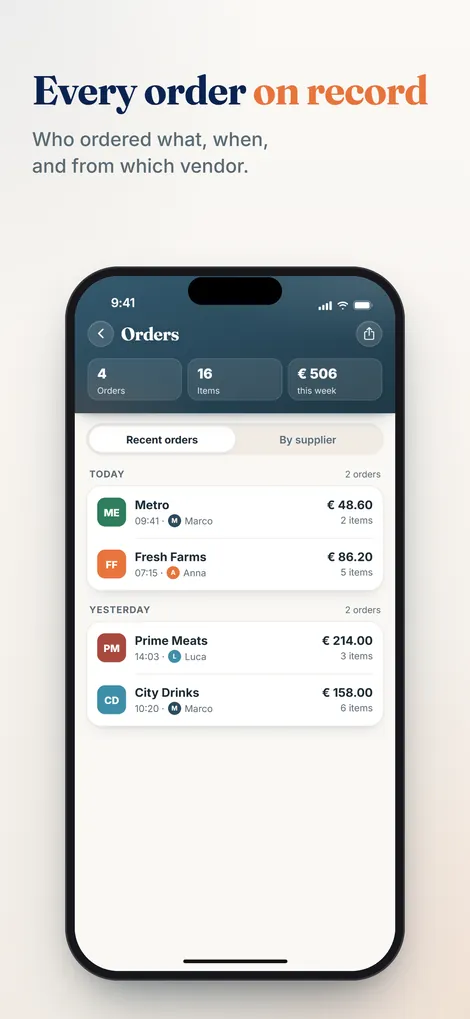
Pelican handles the step just before all this: the order. The team adds what is missing by voice or typing, each in their own language, and the head chef approves one list. The order history shows what was ordered, when, from which supplier and by whom. That helps when you compare a delivery with what you actually ordered, but it does not replace batch records or delivery notes.
Pelican is billed per business, not per user: Solo 19 euros per month (up to 3 users), Basic 29 euros per month (up to 5 users), Pro 59 euros per month (unlimited users). Paid yearly it is 15, 24 or 49 euros per month. Every plan starts with 30 days free.
Frequently asked questions
Is a HACCP plan required for a restaurant?
It depends on the country. EU and UK food businesses must run procedures based on HACCP principles, scaled to their size. In the US, the FDA Food Code requires a formal plan only for special processes such as curing, acidifying or vacuum packing, and your state may add to this.
Do I need a HACCP certificate?
The rules cited in this guide ask for working procedures, not for a certificate on the wall. Food safety training can be required separately, depending on where you are. Ask your local authority what it wants to see.
What are the 7 principles of HACCP?
Hazard analysis, critical control points, critical limits, monitoring, corrective actions, verification, and records.
What is a critical control point in a restaurant?
A step where a measurable check stops a hazard and no later step would catch it. Typical examples are cooking, hot holding, cooling and cold storage.
Can I use a HACCP plan template?
Yes, as a starting point. Safer Food, Better Business is one free example in the UK. Adapt it to your menu, equipment and team, because an inspector will compare it with what happens in your kitchen.
How often should a HACCP plan be reviewed?
Whenever the menu, the processes or the equipment change, and on a fixed schedule as well. Many kitchens do it once a year. EU law requires that the procedures stay up to date.
Less chaos before the delivery even arrives
Pelican brings your team's order list together, in every language in your kitchen. Try it free for 30 days. It does not replace your HACCP plan, it takes the chaos out of ordering.
Create business and try 30 days free