 Pelican
The six routes cross contamination takes in a kitchen
Most cases are not dramatic. Nobody decides to put raw chicken on the salad. It happens in a rush, through something that touched both: the tongs on the grill, the towel on the shoulder, the slicer nobody took apart. Three things can travel this way. Bacteria are the classic case, allergens are the case guests ask about, and chemicals get in when a spray bottle sits next to the prep. Follow the route and you find the fix.
| Route | A typical scene | The fix |
|---|---|---|
| Food to food | Raw chicken juice drips onto the salad box in the walk-in | Raw food on the lowest shelf, everything in closed containers |
| Hands | A cook portions raw fish and then plates a salad | Wash hands at every change of task, gloves do not replace it |
| Boards and knives | The same board for raw meat and then for herbs | Separate boards and knives, or a full clean and disinfection in between |
| Cloths and towels | One towel wipes the bench, the handle and the plate rim | Separate cloths for raw areas and plating, change them often |
| Equipment | Slicer, vacuum packer or thermometer probe used for raw and then for cooked | Separate machines where possible, wipe probes between uses |
| Chemicals and allergens | Spray bottle above the mise en place, flour dust over a gluten free order | Store chemicals apart from food, set a clean routine for allergy orders |
Walk-in shelf order: what goes where
Gravity is the simplest risk in any kitchen. The usual rule follows the cooking temperature: what needs the least cooking sits on top, what needs the most sits at the bottom, so anything that drips lands on food that gets cooked hotter anyway. This is a common example of that order. Your local rules decide the details.
| Shelf | What goes here | Why |
|---|---|---|
| Top | Ready-to-eat and cooked food, covered | It gets no further cooking |
| Second | Washed produce and prepped salads | Eaten raw or barely cooked |
| Third | Raw whole fish | Needs less heat than meat |
| Fourth | Raw whole cuts of beef and pork | Cooked hotter than fish |
| Fifth | Raw ground meat | Must be cooked through |
| Bottom | Raw poultry and items thawing on a tray | Highest cooking temperature, and the most likely to drip |
Chopping board colours: the usual system
Chopping board colours, or cutting board colors in the US, make the rule visible. A new cook can see at a glance which board is for what, even without shared language. This set is the most common one in UK catering. It is a convention and not a world standard.
| Color | Used for |
|---|---|
| Red | Raw meat |
| Blue | Raw fish |
| Yellow | Cooked meat |
| Green | Salad and fruit |
| Brown | Unwashed root vegetables |
| White | Dairy and bakery |
| Purple | Allergen free preparation |
What the rules say about cross contamination
Rules vary by place, and few of them prescribe exact tools. They set the outcome: food is protected, and you can show how.
- United Kingdom The FSA E. coli O157 cross contamination guidance says work areas, surfaces and equipment for raw and ready-to-eat food must be adequately separated. Complex equipment such as vacuum packers, slicers and mincers should not be used for both during a normal business day. Gloves are not a substitute for handwashing, and hand gel does not replace it either. Separating by time and disinfecting shared areas in between is allowed, and it carries the most risk.
- United States The FDA Food Code is a model that states adopt in their own versions. Section 3-302.11 separates raw animal foods from ready-to-eat food during storage, preparation, holding and display. Section 4-602.11 says food contact surfaces in use with temperature controlled food are cleaned at least every four hours throughout the day. Your local health department decides what applies.
- Chopping board colours The FSA guidance named here does not set colours, and neither does the Food Code section above. Colours are a common way to show that your separation works, so ask your inspector what they expect to see.
Six steps to a routine your team can keep
A rule only works if it survives a full Saturday. Build it around how your kitchen actually moves.
- Walk the route of the raw food. Follow a crate of chicken from the back door to the plate. Note every spot where it crosses ready-to-eat food, a shared sink, or a person moving between the two. Those crossings are your list.
- Separate by place first. Give raw prep its own station, sink and tools where you can. A separate area beats any cleaning routine, because it does not depend on someone remembering.
- Separate by time if space is short. In a small kitchen, do ready-to-eat prep first and raw prep later, then clean and disinfect before you switch back. This is the riskiest option, so write it down as a fixed order.
- Assign the tools. Boards, knives, tongs and cloths each get a clear use, and machines stay on one side. Keep spares within reach: the cook who cannot find the right board uses the wrong one.
- Clean first, then disinfect. Remove the debris, wash with detergent, rinse, apply the disinfectant for the contact time on its label, and let it air dry. Disinfectant does not work properly on a dirty surface.
- Train everyone, in a language they understand. Show the routine on the line with new staff on day one. A chart with colors and pictures helps a kitchen with several languages. Then check at service time and correct on the spot.
It starts at the back door and on the order list
Cross contamination does not begin at the board. Delivery crates that stood on a warehouse floor end up on the prep bench. A leaking pack of chicken sits against the lettuce. So your receiving check should include torn packs and raw items packed against ready-to-eat items, and the unpacking should happen away from the prep area. Then the food goes straight into its place in storage.
The other link is the supply of tools. When the only blue board has split and the new one was never ordered, your color system ends on that day. The same goes for gloves, cloths and disinfectant. Treat these items like food: give them a par level and a place on the order.
Improvised
- Crates unpacked on the prep bench
- One board for everything once the others are worn
- Disinfectant runs out on the weekend
- Nobody owns the chart
Planned
- Unpacking area away from prep
- Spare boards in every color you use
- Gloves, cloths and disinfectant on the order
- One named person checks it each week
Common cross contamination mistakes
- Trusting gloves Gloves carry bacteria the same way hands do. Change them whenever you would wash your hands, and wash your hands when you change them.
- Rinsing raw chicken The splash spreads bacteria around the sink and the bench. Food safety authorities such as the UK FSA advise against it. Proper cooking kills the bacteria, rinsing does not.
- Same tongs from raw to done The classic on the grill. Use one set for raw and another for finished food, and keep them visibly apart.
- Reusing a marinade or a tray Whatever touched raw meat stays raw. Boil a marinade properly before you use it as a sauce, or set some aside before the meat goes in.
- Disinfecting without cleaning A spray over grease looks clean and does very little. The detergent step comes first.
- Forgetting the probe A thermometer that goes from raw to cooked without being wiped carries the problem with it. The same goes for phones and tablets touched with dirty hands.
Where Pelican fits, and where it does not
Pelican handles the order, which is the small part of this topic it can touch. If your team buys boards, gloves or disinfectant through its regular supplier, the person who notices a shortage can add it by voice or typing, in their own language, like any other item. The head chef then approves one list.
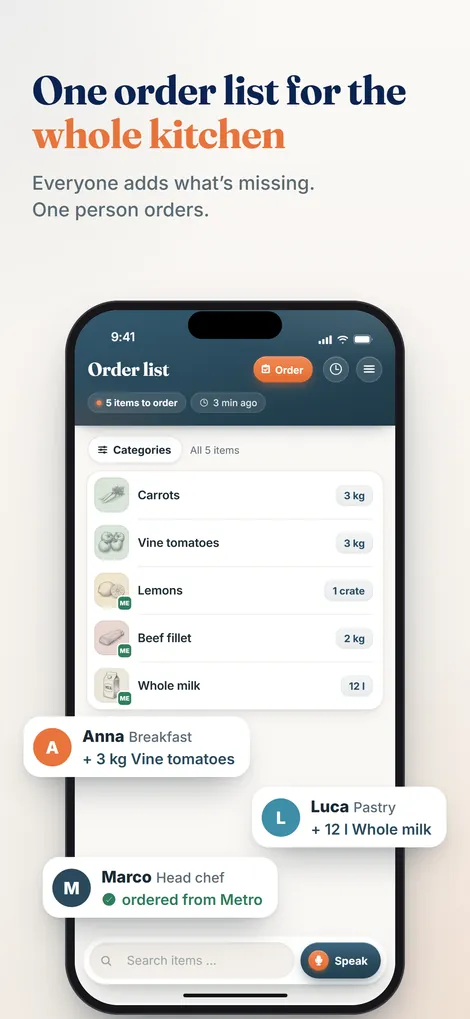
Pelican is not hygiene software. It does not keep cleaning logs, monitor temperatures, check your routine or replace an inspection. It is also not a POS, a guest ordering system or a stock booking tool, and it does not place orders with your suppliers.
Pelican is billed per business, not per user: Solo 19 euros per month (up to 3 users), Basic 29 euros per month (up to 5 users), Pro 59 euros per month (unlimited users). Paid yearly it is 15, 24 or 49 euros per month. Every plan starts with 30 days free.
Frequently asked questions
What is cross contamination?
It is the transfer of bacteria, allergens or other harmful substances onto food, directly from other food or indirectly through hands, surfaces, tools or cloths. Food can look and smell completely normal afterwards.
What are the chopping board colours?
The common UK set is red for raw meat, blue for raw fish, yellow for cooked meat, green for salad and fruit, brown for unwashed root vegetables, white for dairy and bakery, and purple for allergen free preparation. Other countries and suppliers use different sets.
Are colored cutting boards required by law?
The FSA guidance and the Food Code sections named in this guide do not set colours. They require separation and clean equipment. Colours are a common way to achieve that, and your local inspector can tell you what they expect.
What goes on the bottom shelf of the walk-in?
Raw poultry and food that is thawing, on a deep tray or in a closed container. These need the highest cooking temperature and are the most likely to drip.
Does wiping a board stop cross contamination?
No. Wiping moves the problem around. Wash the board with detergent, rinse it, disinfect it according to the label and let it dry, or take a separate board.
Is cross contact with allergens the same thing?
It follows the same routes, but cooking does not remove an allergen. If you cannot rule it out, tell the guest before they order. More in our guide to the 14 allergens.
One order list for the whole kitchen
Pelican brings your team's orders together in every language in your kitchen, including whatever needs replacing. Try it free for 30 days. It does not replace your hygiene routine.
Create business and try 30 days free