 Pelican
What blast chilling and cook chill are
Monday, 9 am. On the range, 78 lb of beef chuck is braising for chili. It will be served today, tomorrow and Wednesday. At 11 it goes into the blast chiller in shallow pans, by 12:30 it is cold, labeled and on the shelf in the walk-in. The last portions get reheated on Wednesday at lunch. That is cook chill: the kitchen cooks when it has time, not when the ticket comes in.
The method comes from institutional catering, but banquet kitchens, caterers and restaurants use it too. It all depends on cooling fast. The terms you will run into:
- Blast chilling Rapid cooling of cooked food with strong, cold airflow. A blast chiller brings hot food down far faster than a walk-in can. Many units have a core temperature probe.
- Cook chill The whole system built on it: cook, blast chill, hold cold, reheat when needed and serve. Production and service happen at different times.
- Blast freezing, cook freeze The same idea, but the food is frozen fast and held frozen. It lasts longer, but takes freezer space.
- Cook and serve, cook and hold The alternatives: cook and serve right away, or cook and keep hot until service. Neither needs chilling, but both tie production to service hours.
Cook chill in five steps
Every step has a target and something you record. The figures below are from the FDA Food Code, which your state or county adopts in its own version. Your food safety plan sets what applies in your kitchen.
| Step | What happens | US target (FDA Food Code) | What you record |
|---|---|---|---|
| 1 Cook | cook through as usual | the final cooking temperature for the food | core temperature, time |
| 2 Blast chill | straight from cooking, in shallow pans, into the blast chiller | 135 to 70 °F in 2 hours, to 41 °F within 6 hours in total | start, end, core temperature |
| 3 Hold cold | covered and labeled in the walk-in | 41 °F (5 °C) or below, up to 7 days, day of prep is day 1 | prep date, use by date |
| 4 Reheat | in batches, quickly, for example in a combi oven | 165 °F (74 °C) for 15 seconds, within 2 hours | core temperature, time |
| 5 Serve | serve right away or hot hold | 135 °F (57 °C) or above | if hot holding: temperature |
The sections are 3-501.14 for cooling, 3-501.17 for date marking and 3-403.11 for reheating for hot holding in the FDA Food Code. How to log temperatures and what applies in the walk-in is in the guide to the temperature danger zone and fridge logs.
Whether a batch cools in time is decided by the core temperature, and that is only as accurate as the probe. How to check it is in the guide to calibrating a thermometer with the ice point method.
Blast chiller or ice bath and shallow pans
A blast chiller is not required. What counts is that food comes down in time. How you get there is up to you, but you have to be able to show it.
Without a blast chiller
- shallow pans instead of deep stock pots
- split big batches, stir in an ice bath
- works for small batches, gets tight for big ones
- time it, or it stays a guess
With a blast chiller
- cools large batches evenly and on schedule
- the probe shows when the target is reached
- some units store the cooling record
- needs space, power and a fixed load
For cook chill at any scale there is hardly a way around a blast chiller, because big batches will not come down in time otherwise. If you only prep a stock or a sauce ahead now and then, an ice bath and shallow hotel pans often do the job.
Worked example: cooking twice a week
An example with round numbers for a braise, service Monday to Saturday. Portion size, cooked yield, chiller capacity and the three day shelf life are example values. Plug in your own.
| Item | Math | Result |
|---|---|---|
| Need per day | 48 portions times 6 oz | 18 lb |
| Amount per batch | 3 days times 18 lb | 54 lb |
| Raw product per batch | 54 lb divided by 70 % cooked yield | about 78 lb |
| Blast chiller cycles | 54 lb at 45 lb per cycle | 2 |
| Production days | Monday for Monday to Wednesday, Thursday for Thursday to Saturday | 2 per week |
| Beef per week | 2 times 78 lb | 156 lb |
Instead of braising six times a week, the kitchen cooks twice. The 54 lb do not fit in one cycle, so the station plans two loads back to back. The math gives 77.1 lb of raw product, which you round up to 78 lb. How to measure your own cooked yield is in the guide to yield percentage.
For purchasing this means two deliveries of 78 lb, each for the morning of a cook day, instead of small amounts every day. The three days including the day of prep are just an example, well inside the Food Code limit. How long your food may be kept is set and justified in your HACCP plan.
What suits cook chill and what does not
Not every dish survives chilling and reheating equally well. These six groups point the way.
- Braises and stews Chili, pot roast, curry, short ribs. They reheat well and often taste better on day two.
- Stocks, soups and sauces Classic prep ahead items. Split big batches so they come down in time.
- Starches in volume Rice, potatoes, beans, grits. Easy to plan, but cool them just as fast as the meat.
- Blanched vegetables Cook briefly, chill right away, then only warm or toss at service. They keep color and bite.
- Desserts and custards Panna cotta, puddings, compotes. They are served cold anyway, so chilling is part of the recipe.
- Less suited: seared and fried food Steaks, cutlets, fries or crispy breading lose what makes them good when reheated. Those stay cooked to order.
What cook chill changes on the order guide
With cook chill, lots of small orders turn into a production plan. Orders follow the cook days, not the daily rush. Watch these points:
- Tie orders to the cook day The raw product has to be on the dock on the morning of the cook day. Order so your supplier can make it, and recalculate the par levels for the raw product.
- Plan walk-in space Three days of finished food take shelf space. Store it covered, apart from raw product, on top, never below raw meat.
- Label every pan Name, prep date, use by date, initials. How that works day to day is in the guide to day dots and food labels.
- Buy matching pans and lids Shallow pans cool faster than deep ones. With one standard size they go from chiller to walk-in to combi oven without transferring.
What the rules ask for
In the US the Food Code gives numbers. In England the law sets the holding temperatures but no cooling time. The key points:
- United States The FDA Food Code is a model. It becomes law when your state or local authority adopts it, often in an earlier edition, so check the version your inspector works from. The cooling, date marking and reheating figures above come from it.
- England The Food Safety and Hygiene (England) Regulations 2013 require chilled food at 8 °C or below and hot held food at 63 °C or above. They set no time for cooling.
- Local advice in the UK Many local authorities advise aiming to cool food below 8 °C within 90 minutes, for example Sandwell Council. Wales, Scotland and Northern Ireland have their own regulations, so ask your environmental health officer.
- Write it into your plan Cooling and reheating are typical control points: limit, measurement, what you do when a batch misses, and who records it. How that looks is in the guide to the HACCP plan.
What counts for your kitchen is what your local health department or environmental health officer expects. If in doubt, ask before you switch.
How to set up cook chill: six steps
This is how you switch without chaos. Start with one or two dishes and only add more once the routine works.
- Pick the dishes. Choose two or three dishes that suit the method and sell in volume, such as a braise and a stock. Start from your mise en place list.
- Plan amounts and days. Work out the need per day, set the cook days and from that the batch size, as in the example above.
- Check capacity. How much does the blast chiller handle per cycle, how many pans fit, how much room is left in the walk-in?
- Set limits and shelf life. Cooling target, cold holding temperature, shelf life and reheating go into your HACCP plan, together with what happens when a batch misses.
- Train the crew. Who loads the chiller, who probes, who labels, who reheats? A short card on the unit helps, especially with changing shifts.
- Change how you order. Tie orders to the cook days, adjust par levels and check after four weeks whether amounts and shelf life fit.
Common mistakes
- Overloading the chiller More than the unit can handle will not come down in time. Two cycles beat one too many.
- Pans too deep A full deep pan cools much slower at the core than two shallow ones.
- Letting it cool on its own first The pot sits on the pass for an hour before it goes in. Cooling starts right after cooking.
- No label, no date Three identical pans in the walk-in and nobody knows which one is from Monday.
- Reheating too much Whatever is left cannot go back into the cooler. Reheat to demand, not ahead.
- Not probing "It felt cold" is not a record. Core temperature and time go on the log.
Where Pelican helps and where it does not
Cook chill runs on a plan, and the plan starts with the order: the 78 lb of chuck have to arrive on Monday morning. Whoever sees that something is running low adds it to the shared order list by voice or typing, in their own language. Pelican merges duplicate entries. The head chef approves the list. In the order history you later see what was ordered when and from which supplier, and if the team enters prices, the spend too. That helps you control food costs, even now that you buy in larger amounts.
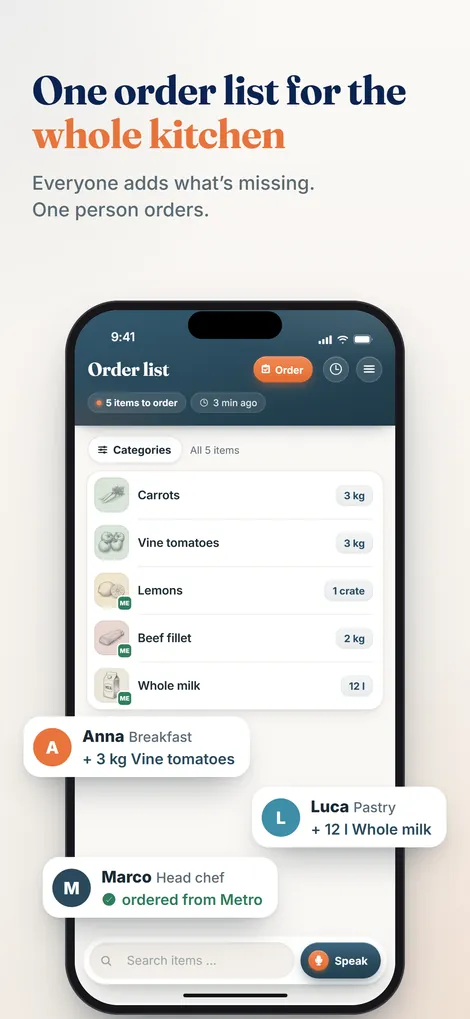
Pelican is not a POS system, not a guest ordering system and not stock accounting, and it does not place orders with suppliers itself. You still order the usual way, with the rep, on the phone or at the cash and carry. Pelican does not measure temperatures and does not keep a cooling log.
Pelican is billed per business, not per user: Solo 19 euros per month (up to 3 users), Basic 29 euros per month (up to 5 users), Pro 59 euros per month (unlimited users). Paid yearly it is 15, 24 or 49 euros per month. Every plan starts with 30 days free.
Frequently asked questions
What is blast chilling?
Blast chilling is rapid cooling of cooked food with strong, cold airflow in a blast chiller. It brings food through the danger zone much faster than a walk-in. Built into a system of cooking, chilling, cold holding and reheating, it is called cook chill. Freezing the food fast instead is blast freezing.
How fast do you have to cool cooked food?
In the US, the FDA Food Code requires 135 to 70 °F within 2 hours and down to 41 °F within 6 hours in total. In England the law sets no cooling time, and many local authorities advise below 8 °C within 90 minutes. Follow the rules your inspector works from.
Do I need a blast chiller?
Not necessarily. You have to show your food cools fast enough. For small batches, shallow pans and an ice bath can do it. For cook chill with big batches, a blast chiller is close to essential.
How long does cook chill food last?
Under the FDA Food Code, ready to eat food held at 41 °F or below may be kept for up to 7 days, with the day of prep as day 1. Your own limit can be shorter and goes into your HACCP plan. The three days in the example above are just an example.
What is the difference between blast chilling and blast freezing?
Blast chilling brings food quickly down to fridge temperature and you store it in the walk-in. Blast freezing freezes it quickly and you store it frozen. Many units can do both.
Can I chill reheated food again?
You should not. Food that has been reheated is served or thrown out. That is why you reheat only what you need for service.
Batch planned, order complete
Pelican collects what your crew needs for the next cook day in one order list, in every language your kitchen speaks. Try it free for 30 days. Chilling and probing stay with your kitchen.
Create business and try 30 days free