 Pelican
Why food thermometer calibration matters
Friday night, full book. On the pass, the line cook probes a chicken breast, the display reads 168 °F and the plate goes out. Nobody knows whether it really is 168 °F, because that probe fell off the pass twice this summer and has not been checked since. Every number on your temperature log is only as good as the thermometer that took it.
Taking core temperatures is one of the most important checks in a kitchen: when cooking, cooling, reheating, hot holding and receiving. To trust the number, you check the thermometer regularly. The terms you will hear:
- Calibration check In a kitchen this usually means measuring a known reference point, such as ice water at 32 °F, and recording how far the display is off. Many people simply call this calibrating.
- Adjusting Setting the thermometer so it reads correctly again. Only possible if it is built for it, for example with the calibration nut on a dial thermometer or a reset function described in the manual.
- Ice point method The check in a slurry of crushed ice and water. It is the most common and most reliable check you can do in the kitchen. The boiling point method checks the top of the range.
- Probe and reference thermometer A probe thermometer measures inside the food. A reference thermometer is a separate unit with a calibration certificate that you use only for comparison.
How to calibrate a food thermometer
The ice point method is the simplest check. Boiling water also checks the top end of the range. The tolerance below is the FDA Food Code accuracy for food thermometers; the UK Food Standards Agency (FSA) gives the same ±1 °C for a digital probe.
| Check | How to do it | Target | If it is off |
|---|---|---|---|
| Ice point | fill a container to the top with crushed ice, add cold water to fill the gaps, stir, hold the probe in the center without touching the bottom or sides, wait until the reading settles | 32 °F, tolerance ±2 °F (0 °C ±1 °C) | adjust if the manual allows, otherwise replace or return |
| Boiling point | hold the probe in water at a rolling boil without touching the bottom of the pot, wait until the reading settles | 212 °F at sea level, ±2 °F | adjust if the manual allows, otherwise replace or return |
| Against a reference thermometer | hold both probes side by side in the same water bath and compare the readings | same reading within your tolerance | take the unit out of service |
| Visual check | stem straight and clean, cable intact, display easy to read, battery not low | all fine | change the battery, retire the unit |
| Infrared thermometer | reads the surface only; if a reading looks high, check it right away with a probe | no target, not for core temperatures | confirm the reading with a probe |
The higher your kitchen sits above sea level, the lower the boiling point of water. At altitude, the ice point method is the more reliable check, or compare with a reference thermometer. The FDA Food Code requires food thermometers to be calibrated in line with the manufacturer's specifications as often as needed to keep them accurate (4-502.11). Where the manual is silent, the FSA suggests once a month as an example.
Probe thermometer or infrared thermometer
Both have a place in the kitchen, but only one reads core temperature. The FSA is clear: an infrared thermometer reads the surface and cannot check the center of cooked, reheated or cooling food.
Infrared thermometer
- reads the surface only
- fast and contact free, handy at receiving and in coolers
- shiny packaging or labels throw it off
- if a reading looks high, confirm with a probe
Probe thermometer
- reads the center, where it counts
- for cooking, cooling, reheating and hot holding
- clean and sanitize before and after every use
- easy to check in ice water
So for your monitoring you need at least one checked probe thermometer at every station that takes temperatures. The FDA Food Code also requires food thermometers to be provided and readily accessible (4-302.12). What to probe at the back door is in the guide to the restaurant receiving log.
Worked example: the monthly check of three thermometers
An example with made-up readings for a kitchen with three probe thermometers: one on the pass, one at receiving, one in pastry. Tolerance is ±2 °F, as in the FDA Food Code. The deviation is the difference between the reading and the target.
| Check | Reading and target | Result |
|---|---|---|
| Thermometer 1 (pass), ice point | 32.6 °F, target 32 °F | 0.6 °F off, OK |
| Thermometer 1 (pass), boiling point | 211.5 °F, target 212 °F | 0.5 °F off, OK |
| Thermometer 2 (receiving), ice point | 33.4 °F, target 32 °F | 1.4 °F off, OK |
| Thermometer 2 (receiving), boiling point | 213.1 °F, target 212 °F | 1.1 °F off, OK |
| Thermometer 3 (pastry), ice point | 35.1 °F, target 32 °F | 3.1 °F off, out of tolerance |
| Thermometer 3 (pastry), boiling point | 209.2 °F, target 212 °F | 2.8 °F off, out of tolerance |
Thermometer 3 is out of tolerance at both points. It comes out of service right away: adjust it if the manual allows and check again, otherwise replace it or send it back. Carrying on with a correction in your head is not a fix, because nobody on the line subtracts 3 °F from every reading.
So that pastry can keep probing today, you need a checked spare thermometer in the drawer. Log every check with the date, unit, readings, result and initials. How often you check and what tolerance you use belongs in your HACCP plan.
How to take a core temperature: six rules
A calibrated thermometer only helps if the reading is taken properly. Most of these six rules come from the FSA guidance.
- Sanitize the probe Clean and sanitize before and after every reading, or you carry bacteria from raw to cooked food. Probe wipes must not dry out.
- Tip in the center The tip goes in the center or the thickest part. On a whole bird that is between the leg and the breast, in a stew it is the largest piece of meat.
- Big batches, several spots In a large pan or pot, probe in several places. The coldest spot is the one that counts.
- Wait for the reading to settle Read only when the number stops moving. Read too early and you read too low.
- Time counts too The FSA gives examples of safe cooking combinations at the center, including 75 °C (167 °F) for at least 30 seconds or 70 °C (158 °F) for at least 2 minutes. In the US, cook to the minimum your local food code sets for the food.
- Write down what counts If the reading is part of your monitoring, it goes on the log with the time and initials. What that log looks like is in the guide to the temperature danger zone and fridge logs.
What to keep in stock
The check itself takes a few minutes. To keep readings from being skipped on a busy day, a few things always need to be on hand:
- One probe thermometer per station Whoever probes on the pass should not have to run to pastry. Plus at least one checked spare in the drawer.
- Batteries Change a low battery right away, so the right batteries sit in reserve, not on next week's order.
- Probe wipes or sanitizer Without sanitizing, the reading itself becomes a risk. Reorder before the pack runs out.
- A reference thermometer if you probe a lot A separate unit with a calibration certificate, used only for comparison. It lets you check several probes side by side.
What the rules require
In the US, the FDA Food Code is the model most states and counties adopt, each in its own version. In the UK, the FSA guidance shows what inspectors expect. The main points:
- Accuracy Food thermometers scaled in Fahrenheit must be accurate to ±2 °F, those in Celsius or both scales to ±1 °C, in their intended range of use (4-203.11).
- Calibration Food thermometers are calibrated in line with the manufacturer's specifications as often as needed to keep them accurate (4-502.11). The code does not set a fixed interval.
- UK: check regularly The FSA says the manufacturer's instructions should tell you how often to check. Without them, check regularly, for example once a month: ice water between 1 °C below zero and 1 °C, boiling water between 99 and 101 °C. Outside that range, replace the probe or return it for calibration.
- Put it in your plan Check frequency, tolerance, what happens when a unit is off and who checks belong in your food safety plan. How that fits together is in the guide to the HACCP plan.
What counts for your kitchen is the version your state, county or local authority enforces. If in doubt, ask your inspector which log they want to see.
Set up a calibration routine: six steps
This turns the ice point check into a routine that survives changing shifts.
- Count and number your thermometers. List every probe thermometer, give each a number or station name and decide where the spare lives.
- Read the manuals. Does the manual say how often and how to check, and whether the unit can be adjusted? That comes first.
- Set frequency and tolerance. For example once a month and after every drop, tolerance ±2 °F. Write it into your HACCP plan.
- Start a calibration log. Columns for date, thermometer, ice point, boiling point, result, action and initials. One sheet a year is often enough.
- Train the team. Show once at the station how the ice point check works and how to probe properly. With new staff it helps in their own language.
- Keep supplies coming. Spare thermometer, batteries and probe wipes go on the order list before they run out.
Common mistakes
- Not enough ice A few cubes in lots of water are not at 32 °F. A good thermometer gets pulled, or a bad one passes.
- Probe touching the bottom In the ice water or the pot, you then measure the container, not the water.
- Reading too early The display is still moving and the number is already on the log.
- Infrared instead of a probe The surface reading ends up on the log as a core temperature.
- Living with an offset "It always reads 3 degrees high" is not a calibration result. A thermometer out of tolerance gets adjusted, replaced or sent back.
- No spare The only thermometer fails, and nobody probes until the next delivery.
Where Pelican helps and where it does not
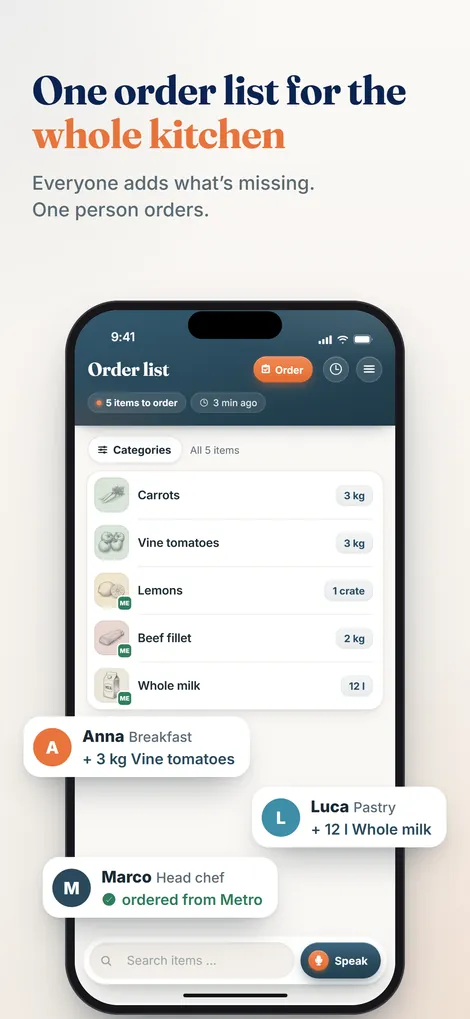
A calibration routine falls apart when there are no batteries or the probe wipes are gone. Whoever sees something running low adds it to the shared order list by voice or typing, in their own language. Pelican merges duplicate entries. The head chef approves the list. In the order history you later see what was ordered when and from which supplier, and if the team enters prices, the spend too. That way the small items show up when you control food costs.
Pelican is not a POS system, not a guest ordering system and not stock accounting, and it does not place orders with suppliers itself. You still order the usual way, with the rep, on the phone or at the cash and carry. Pelican does not take temperatures, does not check thermometers and does not keep a calibration log.
Pelican is billed per business, not per user: Solo 19 euros per month (up to 3 users), Basic 29 euros per month (up to 5 users), Pro 59 euros per month (unlimited users). Paid yearly it is 15, 24 or 49 euros per month. Every plan starts with 30 days free.
Frequently asked questions
How do you calibrate a thermometer with the ice point method?
Fill a container to the top with crushed ice and add cold water until the gaps are filled. Stir, hold the probe in the center without touching the bottom or sides, and wait until the reading settles. A food thermometer should read 32 °F (0 °C). The FDA Food Code allows ±2 °F, or ±1 °C on a Celsius scale. If it is off, adjust it if the manual allows, otherwise replace it.
How often should a food thermometer be calibrated?
The FDA Food Code says as often as needed to keep it accurate, following the manufacturer's specifications. Where the manual gives no interval, the UK Food Standards Agency suggests once a month as an example. Check again after every drop. Set your frequency in your HACCP plan.
What accuracy does a food thermometer need?
Under the FDA Food Code, ±2 °F for thermometers scaled only in Fahrenheit and ±1 °C for those in Celsius or both scales. The FSA gives the same ±1 °C range for a digital probe in ice water and boiling water.
What do I do if my thermometer is off?
Take it out of service right away and use a checked spare. If the manual allows adjustment, adjust it and check again. Otherwise replace it or send it back to the manufacturer. Log the deviation and what you did.
Can I take a core temperature with an infrared thermometer?
No. An infrared thermometer reads the surface only. For the core temperature you need a probe thermometer with its tip in the center or the thickest part of the food.
Why does my thermometer not read 212 °F in boiling water?
The boiling point drops the higher your kitchen sits above sea level. A slightly lower reading may be the altitude, not the thermometer. Check in ice water instead, or compare with a reference thermometer.
Kitchen supplies without the paper list
Pelican collects what your team needs, from chuck to batteries and probe wipes, in one order list and in every language in your kitchen. Free for 30 days. Taking temperatures stays your kitchen's job.
Create business and try 30 days free