 Pelican
What institutional food service is
Eleven thirty in the staff cafeteria. In twenty minutes the first hundred people are in line, and by one o'clock it is over. Whoever cooks here knows on Monday what goes on the plate on Thursday, and roughly for how many. That is the difference from a restaurant: a fixed menu, fixed meal times and guests you know.
Institutional food service, also called non-commercial food service, feeds people in places whose main job is not food. The cooking usually happens in a high-volume kitchen. The main segments:
- Business and industry The staff cafeteria or corporate dining room, often with two or three menu lines and a salad bar.
- Schools and childcare Lunch for children and teenagers, often pre-ordered or based on fixed enrollment, with extra care for allergens and portion sizes.
- Hospitals and care homes Meals around the clock, with modified diets for individual patients or residents.
- High-volume kitchen The kitchen that produces large batches at once. It can serve on site or supply other locations, and then it works as a commissary.
Four food production systems
How the food reaches the plate depends on the production system. It decides equipment, staffing, storage and purchasing:
| System | How it works | Typical for | Watch out for |
|---|---|---|---|
| Cook and serve | Cook and serve right away, fresh on site | cafeterias and dining halls with their own kitchen | the rush just before service and fresh product every day |
| Cook and hold | Cook, hold hot and deliver hot | schools and childcare sites without a kitchen | holding times, because vegetables and pasta suffer fast |
| Cook chill | Cook, chill fast, store cold and reheat before service | hospitals, care homes, commissaries with satellite kitchens | the cold chain, labels and reheating at the serving site |
| Cook freeze | Cook, freeze and reheat before service | sites with small volumes or long delivery routes | freezer space and thawing to a plan |
| Assembly or mixed kitchen | Cook from scratch and combine with prepared components | many corporate dining rooms and school kitchens | a clear rule on what you make and what you buy |
Many kitchens combine systems. The soup runs on cook chill, the main item is cooked fresh, the dessert arrives ready made. How central production for several serving kitchens works is covered in the guide to the commissary kitchen.
Self-operated or contract food service
The second big question is who runs the kitchen. There are two ways:
Self-operated
- the institution runs the kitchen with its own staff
- menu and recipes stay in house
- you buy yourself, from your own suppliers
- you control cost and quality directly
Contract food service
- a contractor runs the kitchen or delivers the meals
- the contract sets the price per meal, the menu and quality
- the contractor buys, often through its own supply agreements
- the institution monitors instead of cooking
For chefs the main change is who orders and who picks suppliers. In a self-operated kitchen that is you. With a contractor you often work with set suppliers and item lists, but you still place the orders for your kitchen.
Worked example: from menu to order
An example with sample numbers: a staff cafeteria plans Wednesday. Line 1 is a chicken stir fry, line 2 a vegetable curry. On the last four Wednesdays it served 290, 310, 295 and 305 meals, so 300 on average. The tally sheet says 60% take line 1 and 40% line 2. The recipe calls for 4 oz of raw chicken breast per portion.
| Item | Math | Result |
|---|---|---|
| Meals on Wednesday | average of 290, 310, 295 and 305 | 300 meals |
| Line 1 chicken stir fry | 60% of 300 | 180 portions |
| Line 2 vegetable curry | 40% of 300 | 120 portions |
| Raw chicken breast | 180 times 4 oz | 720 oz, that is 45 lb |
| Order in 10 lb cases | 45 lb divided by 10 lb is 4.5 | 5 cases, that is 50 lb |
| Buffer | 5 lb is 80 oz, divided by 4 oz | 20 extra portions |
The math: expected meals times the share of the menu line gives the portions, and portions times the raw weight per portion gives the raw product. 180 times 4 oz is 720 oz, or 45 lb. If the poultry supplier packs 10 lb cases, you order 5 cases, so 50 lb. The extra 5 lb covers 20 more portions if line 1 sells better than expected. If your recipe works with cooked weight, divide by the yield percentage first. How to set portion sizes is covered in the guide to portion control.
It needs a fixed rhythm. In the example the order goes to the poultry supplier on Monday at 10 a.m., the delivery arrives Tuesday and is checked at receiving, and on Wednesday the kitchen cooks and serves from 11:30. You work out the vegetable curry the same way, with its 120 portions and the quantities from its recipe.
What a high-volume kitchen does differently from a restaurant
Anyone moving from a restaurant into institutional food service notices the difference quickly. Six things shape the day:
- Fixed meal times Service often lasts only one or two hours. Everything has to be ready before, there is little room to cook more.
- Menu set in advance The menu is fixed weeks ahead, often as a cycle menu that repeats after a set number of weeks. That allows ordering with lead time.
- Meal counts instead of reservations You plan with averages, sign ups or pre-orders. The better the numbers, the less waste.
- Budget per meal The institution or the contract often sets a fixed amount per meal. Every extra portion comes straight out of your food cost.
- Guests with special needs Children, patients, older people: modified diets, allergies and the right portion sizes are part of daily work.
- Standards and tenders Nutrition standards, contracts or public tenders set what goes on the plate and sometimes also where you buy.
Purchasing in institutional food service
In a high-volume kitchen purchasing is tied closely to the menu. Four building blocks help:
- From menu to order guide For each week you work out the quantity per item from the menu, the meal counts and the recipes. What several dishes need, such as onions or cream, becomes one line.
- Fixed delivery days per supplier Fresh meat and produce often come several times a week, dry goods less often. Set for each supplier when you order and when they deliver.
- Par levels for staples Flour, rice, pasta, oil, canned goods and spices work better with fixed par levels than week by week.
- A buffer for late changes Cancellations, visitor groups or a school closure change the count at short notice. Plan a small buffer and set a cutoff for changes to the order.
Food safety, allergens and records
In institutional food service many people eat the same dish, often children, patients or older people. That makes records especially important. Four points belong in your plan:
- HACCP plan Receiving, storage, cooking, cooling, hot holding and service belong in your HACCP plan, with fixed control points and logs.
- Temperatures Hot holding, cooling and reheating all depend on temperature. Which targets apply and how to measure them is covered in the guide to the temperature danger zone.
- Allergens The allergens of every dish are on the menu or at the serving line. How to get that right for every line is covered in the guide to the 14 allergens.
- Retained food samples Many institutions keep a chilled sample of every dish served. If guests fall ill, that helps find the cause. Whether and for how long depends on the country, the institution or the contract.
Schools, childcare, hospitals and care homes often have extra requirements depending on the country and the institution, for example on nutrition standards, allergen labeling, retained samples and records. Check with your local food safety authority and your client what applies to your kitchen.
How to organize ordering in a high-volume kitchen: six steps
This is how you move from ordering by gut feeling to purchasing that matches the menu.
- Track meal counts. For at least four weeks, write down how many meals went out per day and line and what was left.
- Recipes with raw weight. Every dish in the menu cycle gets a standardized recipe with raw weight per portion and yield.
- Build an item list. A fixed list with items, units and pack sizes, using the same names your supplier knows.
- Set the order schedule. For each supplier: order day, cutoff time and delivery day, matched to the menu and the production system.
- Par levels for dry goods. Keep staples on fixed par levels, so only fresh product is worked out week by week.
- Review every week. Compare meal counts, leftovers and extra orders, then adjust the line shares or the buffer.
Common mistakes
- Ordering by gut feeling Without meal counts everyone orders a little extra, and on Friday half of it ends up in the trash.
- Forgetting breaks and long weekends The school is closed, the office half empty, and the order runs as usual.
- A menu without recipes Each shift makes the dish with different quantities, and the order never fits.
- Modified diets not planned The gluten free version comes up in the morning and the ingredients are missing.
- Several orders side by side Diet kitchen, stations and chef order separately, and the same items arrive twice.
- Not reviewing leftovers What is left gets thrown away, but nobody asks why. So the same mistake repeats every week.
Where Pelican helps and where it does not
Pelican helps with purchasing, not with the menu. In the high-volume kitchen the team adds what the next few days are missing to the shared order list by voice or by typing, each person in their own language. Pelican recognizes the product, merges duplicates and sorts the list by category. The chef approves it before the rep visits, and in supplier mode items are checked off with the rep. In the order history you see later what was ordered from which supplier and when.
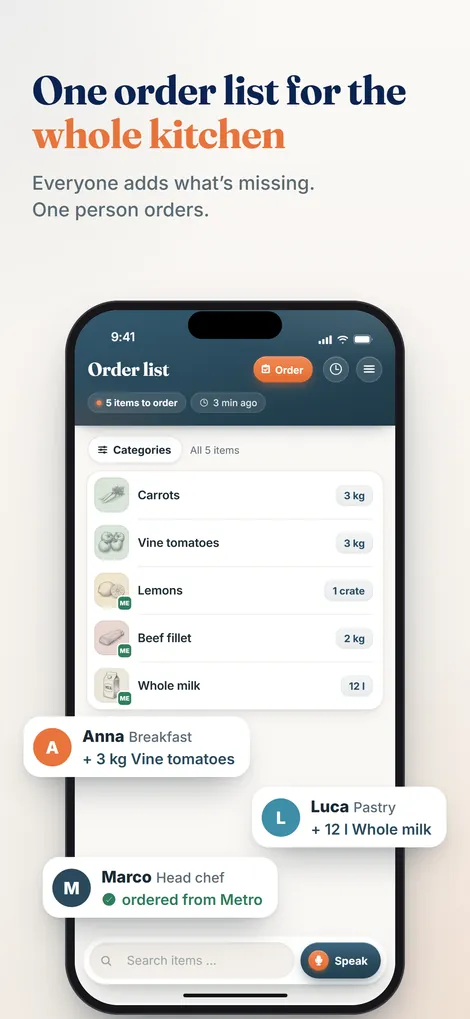
Pelican is not a POS, not a guest ordering system and not inventory accounting, and it does not place orders with your suppliers. You order the way you always do, with the rep, by phone or at the cash and carry. Pelican does not plan menus, does not cost recipes or forecast meal counts, and it is not a system for meal sign ups or billing diners.
Frequently asked questions
What is institutional food service?
Institutional food service, also called non-commercial food service, means meals in places whose main purpose is not food: staff cafeterias, schools and childcare, hospitals and care homes, colleges. Typical are fixed meal times, a menu set in advance and a roughly known number of meals.
What is the difference between commercial and non-commercial food service?
Commercial food service, like restaurants, cafes and hotels, sells food to guests who choose freely. Non-commercial or institutional food service feeds people inside an organization, with a set menu, fixed meal times and a budget per meal.
What are the main food production systems?
The usual ones are cook and serve (cook and serve right away), cook and hold (hold hot and deliver hot), cook chill (chill and reheat before service) and cook freeze (freeze and reheat). Many kitchens combine them with prepared components.
What is contract food service?
In contract food service, also called contract catering, a contractor runs the kitchen, the staff and usually the purchasing for an institution. The contract sets the price per meal, the menu and quality. In a self-operated kitchen the institution does all of that itself.
How does a cafeteria work out its order quantity?
Expected meals times the share of the menu line gives the portions, and portions times raw weight gives the quantity. In the example 60% of 300 meals is 180 portions, and at 4 oz that is 45 lb of chicken breast. In 10 lb cases you order 5 cases, and the extra 5 lb covers 20 more portions.
Which rules apply to institutional food service?
The base is the HACCP plan, as in any kitchen. Schools, childcare, hospitals and care homes often add requirements depending on the country and the institution, for example on nutrition standards, allergen labeling, retained samples and records. Check with your local food safety authority and your client what applies.
Ordering that matches the menu
Pelican collects what your high-volume kitchen team is missing in one order list, in every language in your kitchen. The order history shows what was ordered from whom. Try it free for 30 days. Menus and meal counts stay with you.
Create business and try 30 days free