 Pelican
What portion control is and why it matters
Saturday night, 60 steaks on the board. On the grill the line cook cuts the sirloin by eye, and at the pass the sous chef adds an extra spoon of potatoes because the plate looks empty. Nobody complains. But on Monday the owner asks why the meat order went up again when covers did not.
That is what portion control is about: every portion is the size you planned, no matter who is on the station. It keeps food cost steady, makes plates consistent and turns your order quantities into something you can calculate. The terms:
- Portion size The set weight or volume of one component per plate, for example 6 oz sirloin raw and trimmed, 5 oz potato gratin, 2 fl oz sauce. It belongs on the standardized recipe.
- Portioning Weighing, measuring or scooping on the station, with a portion scale, a disher, a ladle or product that is already cut.
- Portion control Everything that makes the portion size stick in daily service: tools with a fixed size, a plate photo, spot checks during service.
- Raw or cooked Every portion size needs to say whether the weight is raw, trimmed or cooked. Otherwise everyone weighs something different.
Portion control tools
Portioning by eye works as long as one experienced cook runs the station alone. As soon as new hires, extra hands or a slammed night come in, you need tools with a fixed size. The ones that matter most:
| Tool | Use it for | How | Watch out |
|---|---|---|---|
| Portion scale | meat, fish, cheese, anything with a high price per pound | tare first, weigh the piece, then plate it | lives on the station, not in the office |
| Disher (portion scoop) | mashed potatoes, rice, fillings, batters, ice cream | level it off, never heap it | size is marked on the handle; weigh one scoop of your product once to know its weight |
| Portion ladle | soups, sauces, braises | one ladle per portion, full or to the line | set one ladle size for each sauce |
| Ramekins, rings, portion cups | sides, dips, desserts | fill and level | same size for the same dish |
| Pre portioned product | steaks, fish fillets, butter, sauces | order cut to weight from the supplier or portion it yourself during prep and label it | spot check piece weights at receiving |
The scale pays off where a pound costs the most. With meat and fish every ounce counts, with rice a disher with a fixed size is often enough. Whatever you can portion ahead belongs in your mise en place, so nobody has to guess during service.
By eye or by spec
Plenty of kitchens portion well by eye as long as the same people work the same stations. The difference shows when it gets busy or the crew changes:
By eye
- every cook has their own portion
- on a busy night plates get more generous
- food cost moves and nobody knows why
- orders are a guess
By spec
- portion size is on the recipe card
- a tool with a fixed size on the station
- plate cost is known
- order quantity follows from the covers
A spec does not turn the kitchen into a factory. A plate photo and a fixed portion size leave plenty of room for plating. They only make sure the weight is right. How to get from the recipe to the plate cost is in our guide to the standardized recipe.
Worked example: one extra ounce per steak
An example with sample numbers: a restaurant sells 60 sirloin steaks on each of six nights, so 360 portions a week. The spec says 6 oz raw and trimmed. Ten steaks weighed on the grill average 7 oz. The sirloin comes in whole, and 90% is left after trimming. It costs $11.00 per lb.
| Item | Spec (6 oz) | Actual (7 oz) |
|---|---|---|
| Portions per week | 360 | 360 |
| Steak per portion, raw trimmed | 6 oz | 7 oz |
| Trimmed steak per week | 135 lb | 157.5 lb |
| Whole sirloin to buy at 90% yield | 150 lb | 175 lb |
| Purchase per week at $11.00/lb | $1,650 | $1,925 |
| Food cost per plate | $4.58 | $5.35 |
The math: portions times portion size gives the trimmed weight, divided by the yield it gives what you have to buy. 360 times 6 oz is 2,160 oz or 135 lb, divided by 0.9 is 150 lb. At 7 oz it is 157.5 lb and 175 lb. The difference: 25 lb of sirloin and $275 a week, for one dish.
The guest pays the same menu price either way. Food cost per plate goes from $4.58 to $5.35. How to find the yield for your own cuts is in our guide to yield percentage.
How to set portion sizes
A good portion size fits the menu price, the plate and your guests. These six points help you set it:
- Start from the recipe card Every component gets a weight or volume per plate. If a dish has no card yet, write one now.
- Say raw, trimmed or cooked You portion a steak raw and a braise often cooked. Write down which one you mean.
- Check price and plate cost Cost the portion and check it against your menu price. With the expensive components every ounce counts.
- Watch the plate waste If half the side comes back every night, the portion is too big. It is the most honest feedback from the dining room.
- Take a plate photo A photo of the finished plate with the portion sizes hangs at the pass, so everyone sees what the dish should look like.
- Choose menu weights on purpose If the menu says 8 oz sirloin, guests will hold you to it. Decide whether that is raw or cooked weight and stick to it.
What portion size means for your orders
Portion control is not only a question at the pass. It decides how much you have to buy:
- Calculate the order quantity Expected portions times portion size, divided by the yield. That turns next week's covers into the order for the meat or fish supplier.
- Cut to weight from the supplier Many suppliers deliver steaks, fillets or chops cut to a fixed weight. It often costs more per pound but saves labor and trim. Whether it pays off is a conversation with your suppliers.
- Adjust your par When a portion size changes, so does how much you need on hand. Update your par levels.
- Compare orders with covers If the meat order keeps climbing while covers stay flat, portions are usually growing. That is a signal you can check quickly.
How to spot check portions during service
A portion size on paper only helps if it holds during service. The check has to be quick and simple:
- Weigh spot checks Once a week on a normal night, weigh ten portions of the most expensive component and write down the average.
- Watch the pass Whoever runs the pass compares each plate with the photo. Fix it right away, not after service.
- Pay attention to returns What comes back half eaten is too much. What guests keep asking for, like bread or sauce, may be too little.
- Put the numbers side by side Pounds bought per week, portions sold and portion size. If they do not add up, the line is over portioning, product is spoiling or it is walking out the door.
Log the spot checks on a simple sheet: date, dish, spec, average weighed, initials. After a few weeks you see where portions creep up. How to match what you buy with what you sell is in our guide to controlling food costs.
How to set up portion control in six steps
This gets you from portioning by eye to fixed portion sizes without turning service upside down.
- Pick the most expensive dishes. Start with the three to five dishes where the main component costs the most per pound, usually proteins.
- Weigh where you are. On a normal night weigh ten portions of each dish and note the average.
- Set the portion size. Decide weight or volume for each component and whether it is raw or cooked, and put it on the recipe card.
- Put the tools on the station. Scale, dishers and ladles in the right size go where the plates are built. Whatever you can portion during prep, portion during prep.
- Train the team. Show on the station how to portion and hang the plate photo at the pass. New hires get it faster in their own language.
- Adjust your orders. Recalculate the order from portions, portion size and yield, and after a few weeks compare it with what was actually ordered.
Common mistakes
- Only the protein gets weighed Sides, sauces and bread grow without anyone noticing.
- Raw or cooked is unclear The card says 6 oz, one cook weighs it raw, the next one after searing.
- The scale lives in the office If the scale is not on the station, the line guesses.
- Dishers without a set size Everyone grabs whatever scoop is clean, and every size gives a different portion.
- Set once, never checked Without spot checks portions creep up slowly over months.
- Orders by habit The meat order is based on last week's order, not on portions and portion size.
Where Pelican helps and where it does not
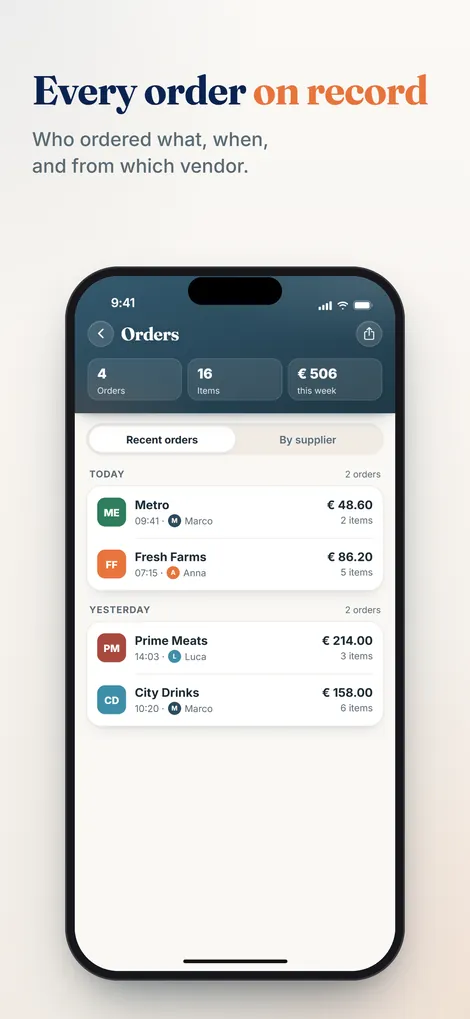
Portioning is the kitchen's job. Pelican helps with the ordering behind it. Whoever sees something running low adds it to the shared order list by voice or by typing, in their own language. Pelican merges duplicates. The chef approves the list. In the order history you see later what was ordered from which supplier and when, and if the team enters prices, the spending as well. If the meat order keeps climbing while covers stay flat, that is where you notice it.
Pelican is not a POS, not a guest ordering system and not inventory accounting, and it does not place orders with your suppliers. You order the way you always do, with the rep, by phone or at the cash and carry. Pelican does not weigh portions, does not cost recipes and does not know which dishes you sold.
Pelican is billed per business, not per user: Solo 19 euros per month (up to 3 users), Basic 29 euros per month (up to 5 users), Pro 59 euros per month (unlimited users). Paid yearly it is 15, 24 or 49 euros per month. Every plan starts with 30 days free.
Frequently asked questions
What is portion control in a restaurant?
Portion control means every portion leaves the kitchen at the set portion size. The size is on the standardized recipe, and the line hits it with a portion scale, dishers, ladles or product cut to weight. The goal is consistent plates, steady food cost and order quantities you can calculate.
How do I set the right portion size?
Start from the recipe card, cost the portion against your menu price and watch what comes back from the dining room. Decide whether the weight is raw, trimmed or cooked. A plate photo at the pass shows everyone what the dish should look like.
How do I calculate the order quantity from the portion size?
Expected portions times portion size, divided by the yield. In the example 360 portions at 6 oz are 135 lb of trimmed steak. At 90% yield you buy 150 lb of whole sirloin.
What does over portioning cost?
In the example with 360 steaks a week, one extra ounce per portion means 25 lb more beef and, at $11.00 per lb, $275 a week for one dish. Food cost per plate goes from $4.58 to $5.35.
Which portion control tools do I need?
A portion scale on the station for meat, fish and cheese, dishers for mashed potatoes, rice and fillings, portion ladles for soups and sauces, and ramekins, rings or portion cups for sides. Add pre portioned product that you weigh out during prep or order cut to weight.
How often should I check portions?
There is no fixed rule. A weekly spot check works well: on a normal night weigh ten portions of the most expensive component and log the average. Check again whenever the recipe or the crew changes.
Order by plan, not by habit
Pelican collects what your team is missing in one order list, in every language in your kitchen. The order history shows what was ordered from whom. Try it free for 30 days. Portioning stays your kitchen's job.
Create business and try 30 days free