 Pelican
The 14 allergens and where they hide in a kitchen
The list comes from UK food law and from Annex II of EU Regulation 1169/2011. Obvious ingredients rarely cause the trouble. Mixes, sauces and bought in products do, so the right column shows where to look. These are typical examples, and the label of the product you actually use decides.
| Allergen | Often found in |
|---|---|
| Cereals containing gluten (wheat, rye, barley, oats) | Flour dusting, roux, breadcrumbs, soy sauce, beer batter, some stock powders |
| Crustaceans | Prawn stock, shrimp paste in curry pastes, bisque |
| Eggs | Mayonnaise, aioli, fresh pasta, glazes on pastry, some breadcrumbs |
| Fish | Worcestershire sauce, Caesar dressing, fish sauce, anchovies in a tapenade |
| Peanuts | Satay, some curry pastes, peanut oil, Asian sauces |
| Soybeans | Soy sauce, tofu, some margarines, bread and chocolate |
| Milk | Butter to finish a sauce, cream, cheese, some sausages and spice blends |
| Tree nuts (such as almond, hazelnut, walnut, cashew, pecan, Brazil nut, pistachio, macadamia) | Pesto, marzipan, praline, nut oils, granola, some dessert bases |
| Celery | Mirepoix, stocks and stock powders, spice salts, soups |
| Mustard | Dressings, mayonnaise, marinades, curry powders, pickles |
| Sesame | Tahini in hummus, sesame oil, bun toppings, furikake |
| Sulphur dioxide and sulphites (above 10 mg per kg or litre) | Wine in a sauce, wine vinegar, dried apricots, some prepared potato products |
| Lupin | Some breads, pastries and gluten free flours |
| Molluscs | Oyster sauce, mussel stock, squid, some seafood mixes |
What restaurants must do: UK, EU and US
The list is similar across markets, but the duty on a restaurant is not.
- United Kingdom Under the government guidance you give information on every non-prepacked dish that contains one of the 14. Do it in writing, on a menu, chalkboard or information pack, or verbally with a clearly visible written notice that tells guests how to get it. The guidance says written information backed by a conversation works best.
- Natasha's Law Since 1 October 2021, food in England, Wales and Northern Ireland that you pack on site before a guest picks it, such as a boxed salad or a wrapped sandwich, needs a label with a full ingredients list and the allergens emphasized. Scotland has similar rules. A plated dish made to order is not covered by this labeling rule, but the duty above still applies.
- European Union Articles 9 and 44 of Regulation 1169/2011 make allergen information mandatory for non-prepacked food, including restaurant dishes. Each member state decides how you give it, so ask your local authority.
- United States Allergens in restaurant food are regulated at state and local level. The FDA Food Code 2022 is a model: where a jurisdiction has adopted it, section 3-602.12 calls for written notice of major allergens in unpackaged food. California also passed SB 68, which from July 1, 2026 requires chains with 20 or more locations to disclose the nine allergens per menu item.
Allergen matrix example
An allergen matrix, also called an allergen chart, is a table with your dishes on one side and the allergens on the other. A full one has 14 columns. For a working version, the kitchen also needs to know where each allergen comes from, so it can check again when something changes. Here is what that looks like for five typical dishes. The recipes are examples, so yours will differ.
| Dish | Source in this recipe | Declare | Check when |
|---|---|---|---|
| Caesar salad | Dressing with anchovy, egg yolk and mustard, parmesan, croutons | Fish, eggs, mustard, milk, gluten | The dressing or croutons are bought in |
| Pasta with basil pesto | Fresh pasta, parmesan, cashews in the pesto | Gluten, eggs, milk, tree nuts | The pesto brand changes |
| Braised beef with red wine sauce | Mirepoix, red wine, stock, butter to finish | Celery, sulphites, milk | The stock base changes |
| Hummus with flatbread | Tahini, wheat flatbread | Sesame, gluten | The bakery changes |
| Green curry with prawns | Prawns, shrimp paste, fish sauce, soy sauce | Crustaceans, fish, soybeans, gluten | The curry paste changes |
Your matrix and your standardized recipes should tell the same story. If a recipe card lists an ingredient, its allergens belong in the matrix. In your HACCP plan, allergens are one of the hazards you have to control.
How to build your allergen matrix in six steps
Plan for one quiet afternoon per menu section. The first version takes the longest, and after that you only maintain it.
- List every dish and component. Include sauces, garnishes, bread, sides, drinks with allergens, and the daily special. Guests ask about the whole plate.
- Collect the labels and specification sheets. For each bought product, keep the current label or supplier sheet. If a product arrives without one, ask the supplier before you use it.
- Mark the allergens per dish. Work through the recipe, not from memory, and note the source ingredient for each mark. Two people checking catch more than one.
- Publish it for guests and staff. Choose the method your rules allow: on the menu, a folder, or a notice that tells guests to ask. Keep one current version at the pass as well.
- Train everyone who serves or cooks. Staff need to know where the matrix is, who to ask, and that guessing is never acceptable. Explain it in a language each person understands.
- Update it on every change. New dish, new recipe, new product or new supplier: change the matrix the same day and date the new version. Remove the old copies.
The supplier swap that breaks your matrix
Here is the scene nobody plans for. Your usual breadcrumbs are out of stock, so the supplier sends a substitute from another brand. The cooks use it, the dish tastes the same, and the new product contains an allergen the old one did not. Your matrix is now wrong, and nothing in the kitchen shows it.
So allergen control starts at purchasing. Write it into your receiving check: when a product differs from what you ordered, compare the label before it goes into storage, and tell whoever owns the matrix. Ask your suppliers to announce substitutions and recipe changes in advance.
A matrix made once
- Written when the menu launched
- Based on the products of that day
- Substitutes go straight to the shelf
- Nobody knows which version is current
A matrix that stays right
- Has a date and an owner
- Every substitute gets a label check
- Recipe changes trigger an update
- Old copies are removed from service
Cross contact and the conversation with the guest
Knowing the ingredients is half the job. The other half is keeping the allergen out of the dish that should not have it, and being honest about when you cannot.
- One clear route The server writes the allergy on the ticket and tells the kitchen directly. One named person in the kitchen confirms the dish.
- Clean before you cook Clean boards, knives and pans, wash hands and change gloves before you start an allergy order. The UK guidance names these controls.
- Watch the shared fryer Oil carries allergens from one batch to the next. If the fries share oil with battered fish, say so.
- Store apart Keep allergen ingredients in closed, labeled containers, away from other food.
- Never improvise an answer "I think it's fine" is the sentence to remove. The right answer is "I'll check" followed by a look at the matrix.
- Say what you cannot promise If cross contact cannot be ruled out, tell the guest before they order. The guidance is clear that you should not offer an allergen free dish you cannot deliver.
Common allergen mistakes in restaurants
- Thinking the list is about main ingredients The trouble usually sits in a stock base, a sauce or a spice blend.
- A matrix without a date Without a date and an owner, nobody can tell whether it still matches the kitchen.
- Printing "may contain" on everything A blanket warning tells guests nothing and does not replace knowing your dishes.
- Leaving out the specials A daily dish needs allergen information as well. Write it on the prep sheet.
- Treating gluten free as a recipe change only Shared fryers and flour in the air can make the promise untrue.
- Only the chef knows If the chef is off and nobody else can answer, the system does not work. A kitchen with several languages also needs the rules in those languages.
Where Pelican fits, and where it does not
Pelican is not allergen software. It does not store allergens, build a matrix or check labels, and it does not replace your documentation or a check by the authorities. It is also not a POS, a guest ordering system or a stock booking tool, and it does not place orders with your suppliers.
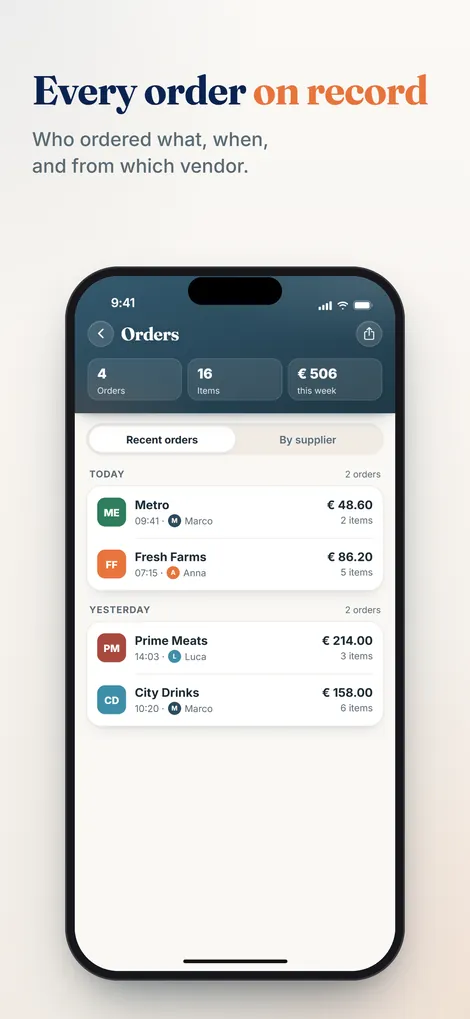
Pelican handles the order. The team adds what is missing by voice or typing, each in their own language, and the head chef approves one list. The order history shows what was ordered, when, from which supplier and by whom, which helps when a delivery differs from your order and you need to spot a substitute. The label check itself stays with you.
Pelican is billed per business, not per user: Solo 19 euros per month (up to 3 users), Basic 29 euros per month (up to 5 users), Pro 59 euros per month (unlimited users). Paid yearly it is 15, 24 or 49 euros per month. Every plan starts with 30 days free.
Frequently asked questions
What are the 14 allergens?
Celery, cereals containing gluten, crustaceans, eggs, fish, lupin, milk, molluscs, mustard, tree nuts, peanuts, sesame, soybeans, and sulphur dioxide and sulphites above 10 mg per kg or litre.
Do restaurants have to list allergens on the menu?
Not always on the menu itself. In the UK you can give written information on a menu, chalkboard or pack, or tell guests verbally if a clear written notice explains how to get it. EU countries set their own method. In the US it depends on your state and city.
What is an allergen matrix?
A table showing which of the allergens each dish contains. Kitchens use it to answer guests accurately and to show an inspector how they manage allergens.
Who does Natasha's Law apply to?
Food businesses in England, Wales and Northern Ireland that sell food packed on site before the guest chooses it. Such food needs a full ingredients label with allergens emphasized. Scotland has similar rules.
How many major allergens are there in the US?
Nine: milk, eggs, fish, crustacean shellfish, tree nuts, peanuts, wheat, soybeans and sesame. Sesame was added from January 1, 2023.
How often should an allergen matrix be updated?
Every time a dish, a recipe, a product or a supplier changes, plus a regular review so that small changes are not missed. Date each version and remove the old ones.
Fewer surprises in the delivery
Pelican brings your team's order list together in every language in your kitchen, with a history of what was ordered. Try it free for 30 days. It does not replace your allergen records.
Create business and try 30 days free