 Pelican
The temperature danger zone: what it is and why it matters
Bacteria need warmth and time. The WHO draws the lines at 5 and 60 °C. In between, microorganisms multiply fast, and you often cannot smell or see it. The limits are not one global law. Each country sets its own, as the table further down shows. For training your team, three zones are enough.
| Zone | Temperature | What it means on the line |
|---|---|---|
| Frozen | −18 °C / 0 °F or colder | Bacteria barely grow but do not die. They are back in play when the food thaws. |
| Chilled | below 5 °C / 41 °F | Growth slows. Some bacteria still grow, so chilled food has a limited life too. |
| Danger zone | 5 to 60 °C | Every minute counts here. The WHO says cooked food should not sit at room temperature for more than 2 hours. |
| Hot holding | above 60 °C | Keeps bacteria in check, but it does not replace cooking through. Many kitchens build in a margin. |
| Cooking | 70 °C as a guide | The WHO figure. Measure at the thickest point, not the edge. |
Food temperature chart: US and England side by side
These are the figures from the FDA Food Code 2026, which US states adopt in their own versions, and the Food Safety and Hygiene (England) Regulations 2013. Food labels can set a stricter limit, and that one applies.
| What | US (FDA Food Code) | England (2013 Regulations) |
|---|---|---|
| Cold holding | 41 °F (5 °C) or below (3-501.16) | 8 °C or below (Schedule 4, para 2) |
| Hot holding | 135 °F (57 °C) or above (3-501.16) | 63 °C or above (Schedule 4, para 6) |
| Cooling | 135 to 70 °F in 2 hours, to 41 °F within 6 hours in total (3-501.14) | No figure in Schedule 4 |
| Tolerance on display or service, cold | Time as a control only under its own rules | Defence if kept under 4 hours and not already above 8 °C (para 5) |
| Tolerance on display or service, hot | Time as a control only under its own rules | Defence if kept under 2 hours, once only (para 7) |
Cooling is only half of it, every container also needs a date. What goes on the label and how FIFO works in the walk-in is in the guide to day dots and date labels for food.
Cooling, thawing, hot holding: where the chain really breaks
The walk-in is usually fine. The risky moments come in between: the big pot of stock after service, the tray of chicken in the morning, the sauce in the bain-marie.
- Cooling Split large batches into shallow pans, use an ice bath or blast chiller, stir. A hot 30-litre pot in the walk-in misses the target and warms the food around it as well.
- Thawing In the walk-in, covered, on a deep tray on the bottom shelf. The WHO advises against thawing at room temperature. Our guide to cross contamination covers the drips.
- Hot holding Bring food up to temperature first, then put it in the bain-marie or steam table. Holding equipment is not designed to reheat.
- Mise en place on the line Pull small amounts and refill often. A reach-in drawer that stays open through service can be warmer than you think, so measure there too.
- Reheating Reheat once and thoroughly, and do not keep it lukewarm. The WHO uses 70 °C as a guide for cooking through and says to reheat cooked food thoroughly. Your local rules may set a specific figure.
If you prep large batches ahead on a regular basis, cool them in a blast chiller, not in the walk-in. How that works as a system, with times and a production plan, is in the guide to blast chilling and cook chill.
What the rules ask you to prove
The rules set the result you must achieve, and you decide how to show it.
- United States The FDA Food Code is a model. It becomes law when a state or local authority adopts it, often in an earlier edition. The 2026 edition's summary of changes lists no change to the cooling and holding sections above. Your local health department decides what applies.
- England Under Schedule 4, keeping food that can support harmful bacteria above 8 °C is an offence unless an exemption applies, and the same goes for keeping it below 63 °C for hot service. The tolerances work as defences, so you must be able to show the facts.
- Your food safety plan Temperature limits, checks and corrective actions belong in your HACCP plan, including how you decide on food that went out of range.
Set up a fridge temperature log: six steps
No single rule sets how often every kitchen must measure. You decide in your plan, and then you stick to it. A log that asks for too much ends up being filled in at the office.
- List your units. Every walk-in, reach-in, drawer, freezer and bain-marie gets a name that everyone knows. Put a sticker on each one with its name and limit.
- Set the limits. Enter the figure for the most sensitive food stored in that unit. The label and your inspector come first, and the chart above gives you the range.
- Name the times and the people. For example at opening and closing, done by whoever opens or closes that station. Name a backup too, or the log stays empty on their day off.
- Measure properly. The display shows air temperature in one spot. Now and then, check the food itself with a probe, or leave a probe in a bottle of water. Clean the probe between raw and ready-to-eat food.
- Check the thermometer. In ice water it should read about 0 °C / 32 °F, and in boiling water about 100 °C / 212 °F at sea level. If it is clearly off, replace or calibrate it, and record the check.
- Plan the action. The last column matters most. Decide in advance who gets called, where the food goes, and what gets thrown out. A deviation with an action is a sign your system works.
Here is how the log can look. The readings are examples, and you enter the limit for each unit yourself:
| Date and time | Unit | Reading | Initials | Action |
|---|---|---|---|---|
| Mon 08:30 | Walk-in (limit 41 °F / 5 °C) | 37 °F / 3 °C | AK | none |
| Mon 08:32 | Freezer (limit 0 °F / −18 °C) | −4 °F / −20 °C | AK | none |
| Mon 22:10 | Reach-in, station 2 (limit 41 °F / 5 °C) | 52 °F / 11 °C | MB | Door found open, food checked, back to 40 °F / 4 °C at 22:40 |
Every reading on this log is only as good as your thermometer. How to check it in ice water, what tolerance applies and what a calibration log looks like is in the guide to calibrating a thermometer.
When the walk-in fails: your emergency plan
Equipment fails at the worst time, often at night and on weekends. Make your plan now, not when the display reads 57 °F. Whether food can still be used depends on the food, the temperature and the time, and no single figure covers everything. When in doubt, throw it out and write it down.
No plan
- Nobody knows how long it has been out of range
- The refrigeration tech's number is in the office
- Food stays in and the door keeps opening
- The smell test makes the decision
With a plan
- The log or an alarm sensor shows since when
- Emergency number is on the unit
- Food moves to another unit and the door stays shut
- Food, reading, time and decision are in the log
The cold chain starts at the back door and on the order
The first check is the delivery. Use your receiving log to spot-check sensitive food, write the reading on the delivery note, and put chilled goods away first. A pallet that waits 20 minutes in the yard because nobody is around is a delivery-window problem, so raise it with your supplier.
The other lever is quantity. An overfilled walk-in cools worse because air cannot circulate, and the door stays open longer while people search. Sensible par levels keep stock to what you can store. Where things go belongs in your stock management.
Common temperature control mistakes
- Reading only the display It measures one spot, often close to the evaporator. By the door it can be several degrees warmer.
- Putting hot pots straight in the walk-in The contents cool too slowly and the food around them warms up. Split and pre-cool first.
- Filling the log in afterwards Identical numbers in the same handwriting stand out to any inspector and do nothing for you. Fewer points that are really measured beat many that are not.
- Recording a deviation and doing nothing A reading of 52 °F with no action shows you knew and did not respond.
- Never checking the thermometer A probe that reads wrong gives you a tidy log full of wrong numbers.
- Trusting the smell test The bacteria that make people sick often do not change how food smells or looks.
Where Pelican helps and where it does not
Pelican handles ordering, the small part of this topic it can touch. When the last probe breaks or the batteries run out, whoever notices adds the item by voice or by typing, in their own language. The head chef then approves one list.
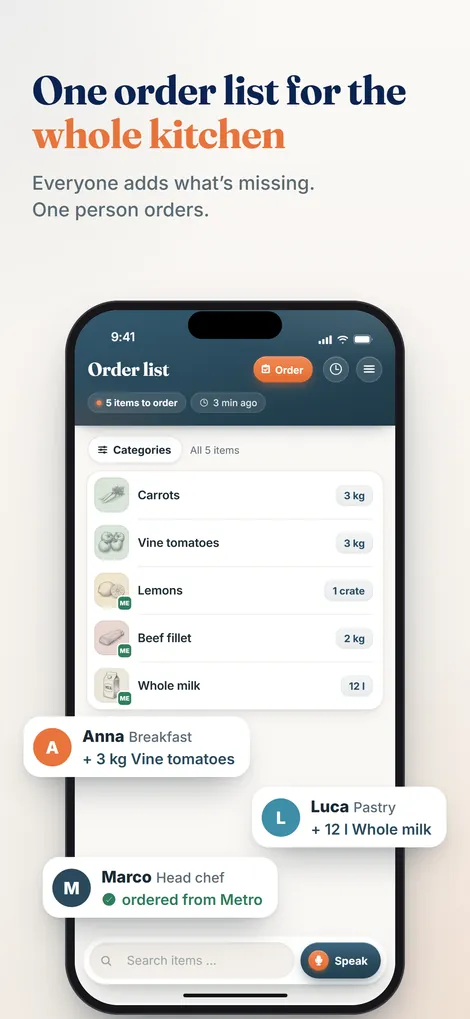
Pelican is not food safety software. It does not measure temperatures, keep a temperature log, raise alarms or replace an inspection. Pelican is also not a POS, not a guest ordering system and not stock accounting, and it does not place orders with your supplier itself.
Pelican is billed per business, not per user: Solo 19 euros per month (up to 3 users), Basic 29 euros per month (up to 5 users), Pro 59 euros per month (unlimited users). Paid yearly it is 15, 24 or 49 euros per month. Every plan starts with 30 days free.
Frequently asked questions
What is the temperature danger zone?
The range where bacteria multiply fast. The WHO puts it at 5 to 60 °C. The US FDA Food Code uses 41 to 135 °F for holding, and the law in England uses 8 and 63 °C. Use the figures that apply where you operate.
How long can food stay in the danger zone?
The WHO says cooked food should not stay at room temperature for more than 2 hours. Other limits depend on your rules: in England, for example, the tolerances on display are under 4 hours cold and under 2 hours hot, under conditions.
What temperature should a commercial fridge be?
In the US, the Food Code requires 41 °F (5 °C) or below for cold holding. In England the legal limit is 8 °C, and the WHO recommends below 5 °C where possible. Many kitchens aim lower than the limit to leave a margin.
How often should I check fridge temperatures?
Most rules leave that to your plan. Many kitchens check at opening and closing. Ask your inspector what they expect, and record any corrective action alongside the reading.
How do I cool food safely?
Split it into shallow pans and use an ice bath or blast chiller. The FDA Food Code requires 135 to 70 °F in 2 hours and down to 41 °F within 6 hours in total.
Does temperature control belong in a HACCP plan?
Yes, either as a critical control point or as part of your basic hygiene, depending on your analysis. Our guide to the HACCP plan explains the difference.
One order list for the whole kitchen
Pelican brings your team's orders together in every language in your kitchen, including that new thermometer. 30 days free. It does not replace your temperature log.
Create business and try 30 days free