 Pelican
What is a scratch kitchen?
Tuesday, 8 am. On the dock sit two cases of potatoes and a tub of peeled ones, vacuum packed. Both end up as home fries on the plate. The difference is the work before that: your crew peels the case, somebody else already peeled the tub. A scratch kitchen is a kitchen that does most of that work itself, starting from raw ingredients.
Nobody does all of it. Even a proud scratch kitchen buys butter, flour and dry pasta instead of churning, milling and drying. So the real question is not scratch or not. It is which items, and at what level of prep. The terms you will run into:
- Scratch kitchen, scratch cooking, scratch made Cooking from raw ingredients in house. A scratch kitchen does that for most of the menu. Scratch made is the same claim for a single dish or sauce.
- Convenience food, convenience products Food where the manufacturer has done part of the kitchen work: washing, cutting, cooking or finishing. It runs from washed salad mix to a finished dessert.
- Speed scratch The middle road: you buy a prepared base, such as a stock, a dough or a cooked protein, and finish it in house with your own ingredients.
- Make or buy The decision behind all of it. For every item on the prep list you choose whether your crew makes it or your supplier delivers it.
From scratch to ready to serve: five levels
There is no official scale in the US. Kitchens in German speaking countries sort convenience products into five levels by how much prep is already done. It is a handy way to look at your own order guide: with every level, more work moves from your line to the manufacturer.
| Level | What is already done | Examples | What the kitchen still does |
|---|---|---|---|
| 1 Prepped | trimmed, peeled, portioned, still raw | peeled potatoes, washed salad mix, fish fillets, portioned meat | cut, season, cook |
| 2 Ready to cook | fully prepped, not cooked | frozen vegetables, dry pasta, breaded cutlets, frozen fries | cook only |
| 3 Ready to mix | dry or concentrated | instant mashed potato flakes, sauce mixes, soup base, pudding mix | add water, whisk, blend |
| 4 Heat and serve | fully cooked | ready meals, canned stew, cooked components in a bag | reheat only |
| 5 Ready to serve | finished | bread and rolls, ice cream, finished desserts, canned fish | portion and plate |
France, Spain, Italy and Portugal sort differently, by how the food is preserved, into five ranges: fresh, canned, frozen, fresh cut and packed (the fourth range) and fully cooked (the fifth range). If you buy from there or have cooks from there on the team, you will hear those terms.
Scratch vs. convenience: what speaks for each
Neither side wins every time. Both have solid advantages, and which ones weigh more depends on the operation, the crew and the dish.
Make it in house
- your own flavor and signature
- full control of ingredients and allergens
- usually cheaper on product cost alone
- you can call it scratch made
Buy it in
- saves labor and prep space
- consistent quality, even when the station changes hands
- predictable cost per portion, hardly any trim
- often a longer shelf life, less spoilage
Most kitchens end up with a mix. What the guest reads as the signature of the house stays in your own hands. What nobody at the table can tell apart and what eats hours comes from the supplier.
Worked example: peel potatoes in house or buy them peeled
An example with round numbers, before sales tax. Prices, yield and the hourly rate are example values. Plug in your own.
| Item | Math | Result |
|---|---|---|
| Raw product | 50 lb case at $0.40 per lb | $20.00 |
| Yield after peeling | 80 % of 50 lb | 40 lb |
| Labor | 40 minutes at $21 per hour | $14.00 |
| Peeled in house, per lb | $34.00 divided by 40 lb | $0.85 |
| Bought peeled, per lb | your supplier's price | $0.75 |
| Difference on 40 lb | 40 lb times $0.10 | $4.00 |
In this example the bought product is $0.10 per lb cheaper, even though the raw product costs far less. If the kitchen goes through 240 lb of peeled potatoes a week, that is $24.00. The hourly rate here means what the hour really costs the business: the wage plus payroll taxes and benefits.
The math flips with labor time. The product alone costs $0.50 per peeled lb, which is $0.25 less than the bought one. On 40 lb that is $10.00. At $21 per hour, $10.00 buys you just under 29 minutes of labor. If your crew gets through the case faster, peeling in house is cheaper. The same is true when the morning hour is paid for anyway and nobody would have anything else to do. How to measure the yield for your own product is in the guide to yield percentage.
Six questions for every item
Price per lb is only part of the decision. For every item you make or buy, run through these six questions.
- How much, and how regular? Large, steady volumes are more likely to justify making it. Nobody sets up a prep task for 5 lb a week.
- Who makes it, and when? Do you have the people and the skill on the station, also during vacations and sick days? If not, quality swings.
- Can the guest taste the difference? A sauce defines the dish, peeled onions do not. Put the labor where it shows up on the plate.
- What does it mean for food safety? With sensitive preparations, such as anything with raw egg, a pasteurized product takes a risk off your hands. Your HACCP plan has to cover both routes.
- Where does it live, and how long does it keep? Bought product needs room in the walk-in or the freezer, but often keeps longer. House made product needs containers, a label and a fixed use by date.
- How dependent does it make you? A product that only one supplier carries can get more expensive tomorrow or be dropped. Line up an alternative before it goes on the menu. More in the guide to restaurant suppliers.
The usual candidates in every kitchen
There is no rule that fits everyone. But these six groups come up for review in almost every kitchen sooner or later.
- Stocks and jus Made in house they cost bones, hours on the stove and energy, but they shape every sauce. A common middle road: make the jus yourself, buy the white stocks.
- Peeled and cut vegetables Potatoes, onions, carrots or salad mix all come prepped. The premium stands against labor, trim loss and waste.
- Fries and potato products Frozen product is even and fast. Fresh cut fries need storage, time and the right potato, but they are a selling point.
- Doughs Puff pastry is a lot of work and easy to buy in good quality. Pie dough or fresh pasta dough is quick to make and shows your hand.
- Dressings, mayonnaise, hollandaise Besides flavor, safety with raw egg counts here. One answer is pasteurized egg or a ready base that you season yourself.
- Desserts, ice cream and bread Without a pastry station and free oven time, buying is often the only road to consistent quality. A house made dessert on the menu still sets you apart.
Scratch does not have to mean fresh every single day. With cook chill you cook twice a week ahead and reheat at service.
What buying in changes on the order guide
Every decision for or against a convenience product moves something on the order guide. Three raw items turn into one finished item, or the other way around. What to watch:
- Ask for the spec sheet Get the specification with ingredients and allergens for every bought product and carry it into your allergen matrix. When the manufacturer changes the recipe, your menu changes with it.
- Check it at receiving Temperature of chilled and frozen product, intact packaging, the date. The steps are in the guide to the receiving log.
- Relabel after opening The date on the pack applies to the closed pack. Once it is opened, it gets its own label with a date and a use by. Here is how with day dots and food labels.
- Adjust the par Product that keeps longer allows more days between deliveries, but it needs space. Recalculate the par level for the new item.
Scratch made on the menu: what you can claim
Using convenience products is legal and normal. It only gets delicate when the menu says something else. The main points in the US and the UK:
- Do not mislead In the US, the FDA Food Code says food has to be offered in a way that does not mislead or misinform the consumer (section 3-601.12, honestly presented). The Food Code is a model. What applies to you is the version your state or county adopted.
- Scratch made means made in house In the UK, food information must not mislead, including about the method of manufacture or production. That is Article 7 of Regulation (EU) No 1169/2011 as kept in UK law, and it covers advertising and presentation too. Calling a bought product house made or scratch made gives the guest a wrong picture of how it was produced.
- Allergens from bought products Finished products bring their own ingredients, often more than you expect. Their allergens belong in your allergen information just like those of the dishes you cook yourself. The basis is the allergen matrix.
- Reheat under control Fully cooked products have to stay cold all the way and get hot enough when you reheat them. Temperatures and a log to check off are in the guide to the temperature danger zone.
Some countries regulate more. France defines fait maison (house made) by law, and Italian courts expect frozen products to be flagged on the menu. For your operation, what counts is what your local health department or trading standards office expects.
Six steps to your own make or buy list
This is how you get from a gut call to a list you can explain. One quiet morning is enough to start.
- List the items. Write down everything your kitchen preps on a regular basis: stocks, sauces, dressings, cleaned vegetables, doughs, desserts. Start from your mise en place list.
- Measure time and yield. For each item, time the real labor once and weigh what is left at the end.
- Work out the cost per lb or quart. Product plus labor, divided by the finished amount. The numbers belong on the standardized recipe.
- Get a quote and a sample. Ask your supplier for price, pack size, shelf life and the spec sheet, and taste the sample blind against your own version.
- Decide and switch. Update the recipe, the allergen matrix, the storage spot and the order guide. Tell the crew why.
- Review twice a year. Prices, staff and the menu change. What was right in spring can be wrong in fall.
Common mistakes
- Comparing product cost only Without labor, making it in house always looks cheaper than it is.
- Deciding on principle All scratch or all bought is comfortable but rarely right. The math is done item by item.
- Not updating allergens The new product contains celery or mustard, and the menu knows nothing about it.
- Leaving scratch made on the menu The recipe changed, the menu did not. Then the claim is no longer true.
- Forgetting opened packs Half a tub sits in the walk-in with no date. Nobody knows since when.
- Never running the numbers again The decision from three years ago still stands, although prices and the crew are long since different.
Where Pelican helps, and where it does not
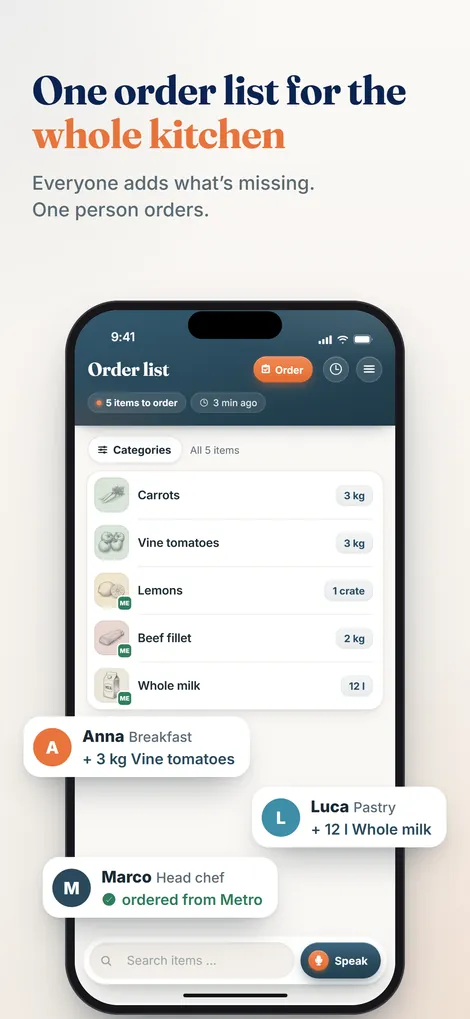
Made in house or bought in, at the end there is an item on the order list: the case of potatoes or the tub of peeled ones. Whoever sees that something is running low adds it to the shared order list by voice or typing, in their own language. Pelican merges duplicate entries. The head chef approves the list. In the order history you later see what was ordered when and from which supplier, and if the team enters prices, the spend too. With those purchase prices you can check whether making it in house still pays, and control your food cost.
Pelican is not a POS system, not a guest ordering system and not stock accounting, and it does not place orders with suppliers itself. You still order the usual way, with the rep, on the phone or at the cash and carry. Pelican does not do the make or buy math for you.
Pelican is billed per business, not per user: Solo 19 euros per month (up to 3 users), Basic 29 euros per month (up to 5 users), Pro 59 euros per month (unlimited users). Paid yearly it is 15, 24 or 49 euros per month. Every plan starts with 30 days free.
Frequently asked questions
What is a scratch kitchen?
A scratch kitchen is a kitchen that makes most of what it serves in house from raw ingredients instead of buying it prepared. It is a description a restaurant gives itself, not a certification. Almost every scratch kitchen still buys staples such as butter, flour or dry pasta.
What does speed scratch mean?
Speed scratch means buying a prepared base, for example a stock, a dough or a cooked protein, and finishing it in house with fresh ingredients. It saves labor and still leaves room for your own signature.
Is scratch cooking always cheaper?
No. Raw product usually costs less, but labor comes on top. In the example above, potatoes peeled in house cost $0.85 per lb and the bought ones $0.75. Only when the case is peeled in under 29 minutes does the result flip.
Can I call convenience products scratch made or house made?
No. Menu claims must not mislead the guest about how the food was produced. House made fits only what is made in your kitchen. If you finish a bought base, describe exactly that.
What are convenience products in a restaurant?
Convenience products are foods where the manufacturer has done part of the kitchen work, from washing and cutting to cooking. Peeled potatoes, frozen vegetables, stock bases and finished desserts all count. A handy way to sort them is by five levels, from prepped to ready to serve.
What are the fourth range and the fifth range?
They come from the French, Spanish and Italian way of sorting food by how it is preserved. The fourth range is fresh raw produce that is washed, cut and packed. The fifth range is fully cooked product that is ready to eat or only needs reheating.
Case or tub: one order list
Pelican collects what your team is missing in the kitchen in one order list, in every language your kitchen speaks. Try it free for 30 days. What you make and what you buy stays your call.
Create business and try 30 days free