 Pelican
What a cleaning schedule is and why your kitchen needs one
It is 11pm and everyone wants to go home. The floor is mopped, the boards are in the dish machine. And the hood filters? Nobody has touched them in weeks, because nobody owns them. That is what a cleaning schedule fixes. It says what gets cleaned, when and by whom, and turns "someone will do it" into a task with a name on it.
People use a few terms for the same thing. A cleaning checklist is the list of tasks, a cleaning schedule adds the frequency, and a cleaning and sanitizing schedule also says where you sanitize after cleaning. In a restaurant they usually end up as one sheet: surfaces, products, frequencies and names. Four reasons to have one:
- Food safety Boards, handles and prep tables carry germs and allergens you cannot see. Looking clean is not the same as being clean.
- Proof An initialed sheet shows an inspector that cleaning happened, not just that it was supposed to.
- Clear ownership Every station knows its tasks. The same person does not end up doing everything, and nothing is left because everyone assumed someone else had it.
- Less waste Mixing to the label uses less chemical than a splash in the sink by feel.
What goes on a restaurant cleaning checklist
A good checklist answers the same questions on every line: what, how, with what, when, who, and who checks. Leave one out and that line gets skipped on a busy night.
| Column | Example | Why |
|---|---|---|
| What | Cutting boards, cold station prep table, hood filters | Every surface and piece of equipment on its own line, not just "kitchen" |
| How | clear, wash, rinse, sanitize | The order decides whether it works |
| With what | detergent, sanitizer, concentration and contact time from the label | The right product at the right strength |
| When | after each task, end of shift, weekly | Without a frequency it becomes "when we get to it" |
| Who | cold station, dishwasher, opening crew | A station or a role, never "everyone" |
| Check | date, initials, sous chef walk through | Initialed means provable |
Cleaning and sanitizing: two steps, not one
Cleaning removes what you can see: grease, food soil, scale. Sanitizing reduces what you cannot see: germs. A sanitizer only works reliably on a clean surface, which is why cleaning always comes first. Spraying sanitizer on a greasy board costs money and does little.
Cleaning
- Removes dirt, grease and food soil
- With detergent and warm water
- Always the first step
- Often enough for floors and walls, depending on your hazard analysis
Sanitizing
- Reduces germs on clean surfaces
- With sanitizer and the contact time on the label
- Only after cleaning
- For food contact surfaces and equipment, especially after raw meat, fish and eggs
A clean and sanitize cycle on the line almost always runs the same way:
- Clear Food off, scrape or wipe off loose soil.
- Wash Detergent and warm water, with some elbow grease: a brush or pad, not just a wipe.
- Rinse Remove detergent residue with clean potable water.
- Sanitize Apply sanitizer at the right concentration and leave it for the contact time on the label. Only then has it done its job.
- Rinse again if required If the manufacturer calls for a final rinse on food contact surfaces, rinse with potable water.
- Air dry Let it air dry or use single use towels, not the side towel from lunch service.
Worked example: mixing sanitizer to the label
The label of a concentrate gives the dilution, often in fluid ounces per gallon or as a percentage. An example: the label says 2 fl oz per gallon for food contact surfaces, and you fill a three compartment sink with 3 gallons in the sanitizing compartment. The numbers are an example. Your product's label always wins.
The math: 3 gallons × 2 fl oz = 6 fl oz of concentrate. In metric, as UK kitchens measure it, a label that says 0.5% means 40 ml of concentrate in an 8 litre bucket (8,000 ml × 0.005 = 40 ml). Write the finished amount for your usual containers on the schedule, for example "sink, 3 gal: 6 fl oz", so nobody does math during service. In the US, section 4-302.14 of the Food Code also requires a test kit that measures the concentration of sanitizing solutions, so check the mix with test strips instead of guessing.
How often: daily, weekly and monthly cleaning tasks
How often something gets cleaned depends on how fast it gets dirty and how close it is to food. In the US, the FDA Food Code sets some frequencies for food contact surfaces (see below). For everything else, this split is common and a good starting point. Treat it as an example:
- After each task Cutting boards, knives, prep tables and equipment that touches food, especially when you switch from raw to ready to eat.
- End of shift All prep surfaces, range and fryer exteriors, sinks, floors, handles and switches, trash out.
- Daily Reach in coolers and lowboys outside, door gaskets, dish machine as the manufacturer says.
- Weekly Reach in coolers inside, hood filters, shelving, ovens and combi ovens deep cleaned, floor drains.
- Monthly Walk in cooler and freezer with floor and shelving, walls, light fixtures, the spots behind and under equipment.
- Right away When something spills or a surface is visibly dirty, whatever the schedule says.
Sample kitchen cleaning schedule
A section of a cleaning schedule for a restaurant kitchen. Copy the columns, replace the examples with your surfaces, equipment and products, and post it where the cleaning happens.
| What | How and with what | When | Who | Done |
|---|---|---|---|---|
| Cutting boards | dish machine, cycle per manufacturer | after each task | station using them | initials |
| Cold station prep table | wash, rinse, sanitize, contact time per label | after each task and end of shift | cold station | initials |
| Kitchen floor | sweep, mop with detergent | end of shift | dishwasher | initials |
| Hot line lowboy, inside | empty, wash, sanitize, dry | weekly, Monday | hot line | date, initials |
| Hood filters | dish machine or soak per manufacturer | weekly, Friday | dishwasher | date, initials |
| Walk in cooler with floor | empty, wash, sanitize | monthly, first Monday | sous chef plus one | date, initials, check |
What the FDA Food Code and the UK FSA say
The rules differ by country, and in the US by state and county. Here is what the main references say about cleaning.
- US: frequency Under section 4-602.11 of the FDA Food Code 2026, food contact surfaces and utensils must be cleaned before working with a different type of raw animal food, when you change from raw to ready to eat food, and at any time contamination may have occurred. Used with time/temperature control for safety food, they must be cleaned throughout the day at least every four hours, with listed exceptions.
- US: sanitizing and chemicals Section 4-702.11 requires utensils and food contact surfaces to be sanitized before use after cleaning. Section 7-201.11 requires poisonous or toxic materials, which include cleaning chemicals, to be stored so they cannot contaminate food, equipment or utensils, separated and not above them. States adopt the Food Code on their own, so ask your local health department.
- UK: the schedule itself The Food Standards Agency's cleaning guidance tells food businesses to set up a cleaning schedule and record, covering what needs to be cleaned or disinfected, how often and which products to use. It says to check that disinfectant labels carry BS EN 1276 or BS EN 13697, and to store cleaning products away from food. Your Environmental Health Officer at the local authority is the contact.
Build a cleaning schedule in six steps
A schedule only the chef knows about ends up yellowing on the wall within weeks. This order helps it stick.
- Walk the kitchen. Go through the kitchen, walk in, dry storage, dish pit and staff areas with a notepad and list every surface and piece of equipment. Include door handles, switches, the ice machine, the walk in floor and the spots behind equipment.
- Pick the products. One detergent and one sanitizer for food contact surfaces, specialty products like degreaser or descaler only where needed. Fewer products, fewer mix ups.
- Add method and frequency. For each line: how, with what, at what dilution and how often. Put the finished dilution for your containers right on the sheet.
- Assign owners. Every line gets a station or a role. Whatever belongs to a station in the kitchen brigade gets cleaned by that station.
- Post it and train. Post the schedule where the cleaning happens and walk everyone through it once, part timers included. In mixed crews, pictures and short sentences help; how to bridge languages is in the guide to the multilingual kitchen team.
- Check and adjust. Whoever finishes initials it. Once a week someone in charge checks that the surface is actually clean. New equipment or a new product? Update the schedule the same day.
Storing cleaning supplies and reordering in time
Chemicals do not belong on the shelf above the prep table. Keep them in their own cabinet or room, away from food, in the original container with the label. Pouring concentrate into an empty water bottle is a mix up waiting to happen. How to organize storage is in the guide to restaurant stock management.
And a schedule is useless if the sanitizer runs out on Friday night. Detergent, dish machine chemicals, gloves, trash bags and single use towels belong on the same order list as butter and flour, with their own par level. The person who opens the last jug should call it out, not the person who finds it empty.
Common cleaning schedule mistakes
- Sanitizing without cleaning No sanitizer works reliably on grease and food soil. Clean first, then sanitize.
- Skipping the contact time Spray and wipe straight away is just wetting the surface. The time is on the label.
- Mixing by feel A splash in the sink is not a dilution. Use a measuring cup or a dispenser.
- One cloth for everything Wiping the floor, the board and the pass with the same cloth spreads the dirt around. Separate cloths by area and change them often.
- Initialed but not done Initials are no substitute for a look. Spot checks by the sous chef keep the schedule honest.
- Forgotten spots Door handles, walk in handles, light switches, the ice machine, floor drains and the floor under equipment are easy to forget. Put them on the schedule by name.
Where Pelican helps and where it does not
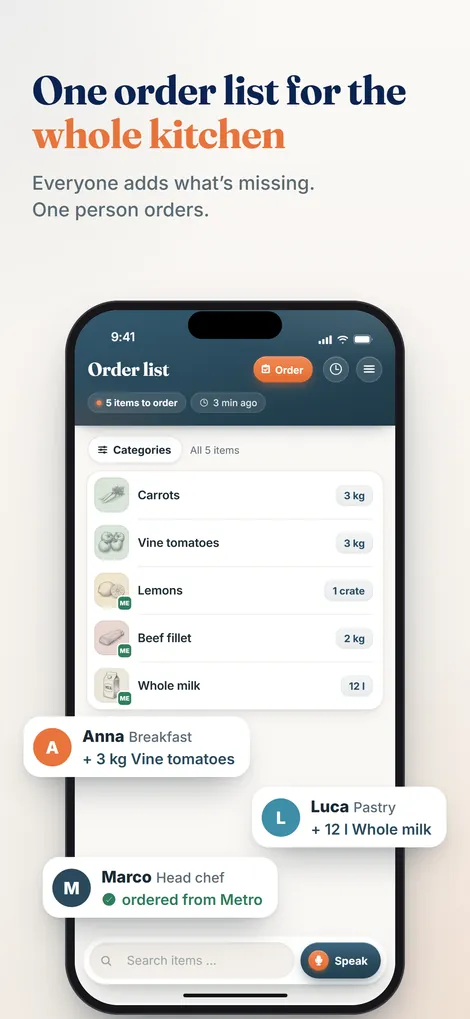
Pelican does not write your cleaning schedule and does not keep cleaning records. It helps at a different point: whoever notices during cleanup that sanitizer, gloves or trash bags are running low adds it to the shared order list by voice or typing, in their own language. The head chef approves the list, and the order history later shows what was ordered when and from which supplier.
Pelican is not a food safety tool and not HACCP documentation. It is also not a POS, not a guest ordering system and not inventory accounting, and it does not place orders with the supplier itself.
Pelican is billed per business, not per user: Solo 19 euros per month (up to 3 users), Basic 29 euros per month (up to 5 users), Pro 59 euros per month (unlimited users). Paid yearly it is 15, 24 or 49 euros per month. Every plan starts with 30 days free.
Frequently asked questions
Is a cleaning schedule required for restaurants?
In the UK, the Food Standards Agency tells food businesses to set up a cleaning schedule and record that covers what is cleaned or disinfected, how often and with which products. In the US, the FDA Food Code sets cleaning frequencies for food contact surfaces rather than a specific form; your local health department decides what records it wants to see.
How often should food contact surfaces be cleaned?
Under the FDA Food Code, before switching between types of raw animal food, when changing from raw to ready to eat food, whenever contamination may have occurred, and at least every four hours during continuous use with time/temperature control for safety food, with listed exceptions.
What is the difference between cleaning and sanitizing?
Cleaning removes visible soil, grease and food residue with detergent and water. Sanitizing reduces germs on a surface that is already clean, with a sanitizer at the right concentration and contact time. Cleaning always comes first.
How do I mix sanitizer correctly?
Follow the label. If it says 2 fl oz per gallon, 3 gallons of water need 6 fl oz of concentrate. Write the finished amount for your containers on the schedule and respect the contact time.
Do I need to keep cleaning records?
The UK FSA guidance talks about a cleaning schedule and record. In the US it depends on your state and local health department. An initialed sheet with dates is the simplest way to show that cleaning happened.
Where should cleaning chemicals be stored?
Away from food, in their own cabinet or area and in the original labeled container. The FDA Food Code requires poisonous or toxic materials to be separated from food, equipment and utensils and not stored above them.
When the sanitizer runs low, it is on the list right away
Pelican collects what your crew notices is missing on the line and in the dish pit in one order list, in every language your kitchen speaks. Try it free for 30 days. It does not write your cleaning schedule.
Create business and try 30 days free