 Pelican
What the kitchen brigade system is
The brigade de cuisine is a way of splitting a professional kitchen into clear roles. It is usually credited to Georges Auguste Escoffier, who organised the kitchens of large hotels such as the Savoy in London in the late 19th century, with a chain of command modelled on the army. Every cook has one station, one boss and one job during service.
The idea has outlived the grand hotel kitchens because it solves a problem every kitchen still has. When a dozen people cook at the same time, everyone needs to know who decides, who preps what and who is responsible when something runs out. Few kitchens today run the full classic brigade. Most use a compressed version that follows the same logic.
The roles in the kitchen hierarchy
From top to bottom, these are the positions you will meet in a classic kitchen brigade. Not every kitchen has all of them, and the exact titles vary between countries and houses.
- Executive chef Runs several kitchens or outlets, for example in a hotel with a restaurant, banqueting and room service. Writes menus, sets budgets, hires and spends more time in the office than at the stove.
- Head chef (chef de cuisine) Leads one kitchen. Head chef responsibilities include the menu, recipes and portion sizes, the rota, quality at the pass, food cost and the final say on what gets ordered.
- Sous chef The deputy. Sous chef duties cover running service when the head chef is off, training the team, checking the mise en place and, in many kitchens, putting together the daily order.
- Chef de partie Runs one station (the partie) and its commis. Responsible for the prep, the quality and the stock of that station.
- Chef tournant The relief cook who can work every station and covers days off, holidays and sickness.
- Commis Junior cook on a station. Preps, learns the dishes and works under the chef de partie.
- Aboyeur or expediter Calls the tickets at the pass and makes sure each table's dishes leave together. In many kitchens the head chef or the sous chef does this.
- Kitchen porter (plongeur) Washes pots and dishes, keeps the kitchen clean and often takes in the deliveries.
The classic stations
In the full brigade, each chef de partie has a fixed specialty. The French names are still used in many kitchens around the world:
| Station | What it covers |
|---|---|
| Saucier | Sauces, often sautéed dishes and stews |
| Poissonnier | Fish and shellfish |
| Rôtisseur | Roast and braised meat; large brigades add a grillardin for the grill |
| Entremetier | Vegetables, potatoes and starches, soups, egg dishes |
| Garde manger | Cold kitchen: starters, salads, terrines, cold sauces |
| Pâtissier | Desserts, pastry and often the bread |
A kitchen hierarchy for a small team
A restaurant with six people in the kitchen cannot run six stations plus an expediter. It merges them. A common split: the head chef works the pass and calls the tickets, the sous chef runs the hot section, one chef de partie takes cold starters and desserts, a second one covers fish and garnish, a commis rotates where the pressure is, and a kitchen porter handles wash up and deliveries.
Classic brigade
- One cook per specialty
- Expediter as a separate role
- Ordering through the sous chef or a purchasing office
- Suits large hotel kitchens and banqueting
Small team
- One cook covers two or three stations
- Head chef calls the tickets
- Every station reports, the head chef approves
- Clear owners matter even more, because nobody has spare time
What must not get lost when you merge stations is ownership. If the cold station also does desserts, it also owns the cream, the berries and the gelatine. Write that down once. Otherwise everyone assumes someone else has checked.
Who orders what in the brigade
This is where brigades fail most often in practice. Service runs smoothly, but at two in the afternoon, when the rep walks in, nobody knows exactly what is missing. The station that uses a product notices first when it runs low. The person who signs off the order needs the overview and the budget. Split the work along those lines:
| Role | Ordering task |
|---|---|
| Commis | Says what ran out during prep instead of quietly working around it |
| Chef de partie | Checks the station before closing and reports everything below par |
| Sous chef | Collects the reports, removes duplicates, checks quantities against the bookings |
| Head chef | Approves the list, decides on substitutes and prices, talks to the rep |
| Kitchen porter | Takes in the delivery, puts it away and reports short or damaged goods |
How much each station should hold is a separate question. The guide to par levels shows how to set a target stock per product, so that below par means the same thing to everyone on the team.
Set up ordering responsibility in five steps
- Assign products to stations Every product on your order guide gets one station that owns it. Shared items such as butter or cream go to the station that uses the most.
- Fix a check time Each chef de partie checks the station fridge and dry store at the same time every day, for example at the end of lunch prep, well before the rep arrives or the order cut off.
- Report to one list All reports land on one shared list, not on three notes, a whiteboard and a text message.
- Consolidate and approve The sous chef merges duplicates and checks quantities against the coming days. The head chef approves. Nobody orders past the approval.
- Keep a record Note what was ordered, when, from which supplier and by whom. When the same mistake comes back, you can see where it started.
How the whole cycle runs from the first report to the delivery is described step by step in the guide to the restaurant ordering process.
Where Pelican fits in the brigade
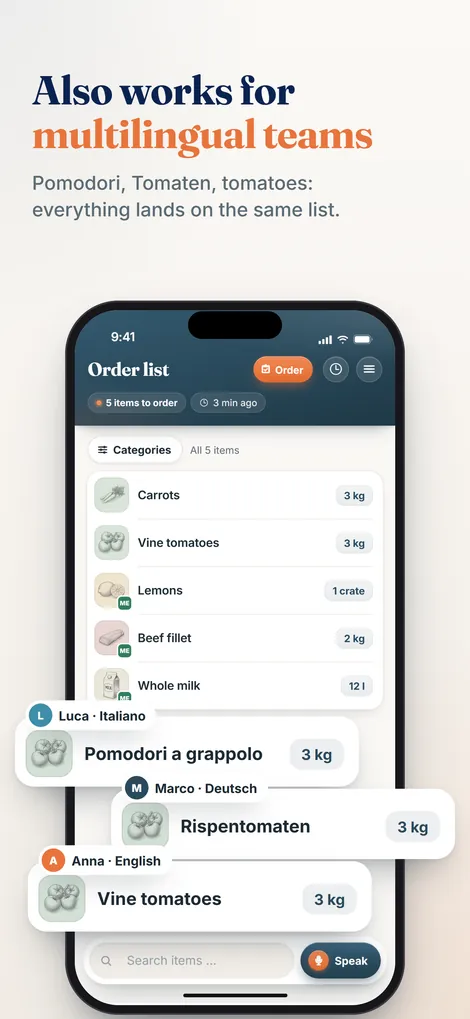
Pelican is built for exactly this split. Every member of the team adds what is missing by voice or by typing, in German, Italian or English. Pelican recognises the product, merges duplicates and builds one list sorted by category. The head chef approves the list before the rep visits or the order goes out, and the order history shows what was ordered, when, from which supplier and by whom.
What Pelican is not: it is not a POS, it does not book stock in and out, it is not a guest ordering system and it does not replace your suppliers or the price talk with the rep. It does not write your rota or decide your stations either. That stays the head chef's job. Pelican is billed per business, not per user: Solo 19 euros per month (up to 3 users), Basic 29 euros per month (up to 5 users), Pro 59 euros per month (unlimited users). Paid yearly it is 15, 24 or 49 euros per month. Every plan starts with 30 days free.
Frequently asked questions
Who is above the head chef?
In hotels and restaurant groups, the executive chef, who is responsible for several kitchens or outlets. In a single restaurant the head chef usually reports directly to the owner or the general manager.
What is the difference between a head chef and a sous chef?
The head chef leads the kitchen and decides on the menu, food cost, the team and what gets ordered. The sous chef is the deputy: runs service when the head chef is off, trains the team and in many kitchens prepares the daily order for the head chef to approve.
Is the kitchen brigade system still used today?
Yes, mostly in adapted form. Large hotel kitchens and banqueting stay close to the classic brigade. Restaurants with small teams merge stations, but keep the core idea: one owner per task and a clear line of who reports to whom.
What does a chef de partie do?
A chef de partie runs one station: its mise en place, the quality of its dishes during service, the commis working there and the stock of that station. That makes the chef de partie the right person to report what the station needs.
Who should place the order in a restaurant kitchen?
The stations report what they need, one person consolidates the list, usually the sous chef, and the head chef approves it. Who then sends it or talks to the rep can vary. What matters is that there is one list and one approval.
One list for the whole brigade
Every station reports what is missing, in its own language. The head chef approves before the order goes out. Try it with your team, free for 30 days.
Create business and try 30 days free