 Pelican
Why kitchens have their own language
Friday, 8 pm, full house. The sous chef is calling tickets at the pass, the fryer is beeping, someone carries a hot sheet pan behind the grill. There is no time for full sentences. Everyone on the line needs words they understand instantly and cannot get wrong.
That is why every professional kitchen has its own kitchen lingo: a small set of fixed calls and terms, many borrowed from French, some pure restaurant slang. It does four jobs:
- Short One word instead of a sentence. "Fire table 12" tells the station everything it needs.
- Unambiguous Each term means exactly one thing. Hear "behind" and you stop, you do not step back.
- Confirmed Every call gets an answer, usually "heard" or "yes, chef". That is how the pass knows it landed.
- Shared The terms apply to everyone, from the executive chef to the new dishwasher on day one.
The calls you hear on the line
You will hear these calls in almost every professional kitchen. The exact words vary from house to house, the meaning does not:
| Call | What it means | What you do |
|---|---|---|
| "Heard!" or "Yes, chef!" | the call was heard and understood | answer every call from the pass, loud enough |
| "Fire table 12!" | start cooking the next course for that table now | confirm, then cook and plate |
| "Hands!" or "Service, please!" | plates are up at the pass and need a runner | servers pick up right away so nothing dies in the window |
| "Behind!" | someone is walking right behind you | stay put, do not step back |
| "Hot!" or "Hot behind!" | a hot pot, pan or sheet tray is coming through | make room, do not turn around |
| "Sharp!" or "Knife!" | someone is carrying a knife through the kitchen | make room; whoever carries it keeps the tip down |
| "All day" | the total of one item across all open tickets, like "eight strip steaks all day" | the station keeps count and preps the right amount |
| "86!" | a dish or ingredient is out | the pass tells front of house at once |
What matters is not which word your kitchen uses but that everyone uses the same one. Who stands at the pass and how the roles are split is in our guide to the kitchen brigade system.
86: what has to happen after the call
To 86 something means to take it off the menu because it has run out: "86 the salmon" or "salmon is 86". Nobody knows for sure where the number comes from; there are several stories and none is proven. What matters more is what happens after the call:
- Call it Whoever sees something running out says so at the pass right away. Not when the next ticket comes in.
- Tell front of house The pass passes it on to the servers so nobody sells a dish the kitchen cannot make.
- Put it on the order list Whatever is 86 goes straight onto the list for the next order. Otherwise it is 86 again tomorrow.
- Find the cause Ordered too little, portioned too big or just a busy night? After service, check whether your par levels still fit.
If the same item keeps getting 86ed, it is rarely the night. It is the order quantity or the portion. How portion size drives your order quantity is in our guide to portion control.
Ticket and pass terms
Between front of house and the kitchen, almost everything runs through the ticket and the pass. Everyone on a station should know these terms:
| Term | Meaning |
|---|---|
| Ticket (chit) | the order from front of house, printed or on the kitchen screen |
| Pass (window) | where finished plates go from the kitchen to the servers; usually the chef or sous chef stands here |
| Expo (expediter) | the person at the pass who calls tickets, checks plates and calls for hands |
| On the fly | needed right now, ahead of everything else, often to fix a mistake |
| In the weeds | a station is so far behind it cannot keep up without help |
| Dying in the window | plates sitting at the pass too long and going cold |
| Refire | cook a dish again, for example after it came back |
| Family meal | the staff meal before or after service |
Terms from the brigade
A lot of kitchen terminology comes from the classic French brigade. You hear it every day, even in small kitchens:
- Chef de partie The station chef, responsible for one station such as grill, fish or vegetables.
- Commis A junior cook on a station who works under the chef de partie.
- Saucier The sauce station, often also in charge of sautéed meat.
- Entremetier The station for vegetables, starches, soups and eggs.
- Garde manger The cold kitchen: salads, cold starters, pantry.
- Mise en place Everything prepped and in its place before service. More in our guide to mise en place.
Storage and ordering terms
Kitchen lingo does not stop at the pass. In the walk-in and when ordering, it helps when everyone uses the same words:
- Walk-in The walk-in cooler or freezer. "It's in the walk-in" means in the back, not in the lowboy on the line.
- FIFO First in, first out: whatever arrived first gets used first. That only works with day dots and dated labels.
- Par The amount you want on the shelf after each delivery. The order quantity follows from it.
- Receiving Checking a delivery against the invoice before it goes on the shelf. How that works is in our guide to the receiving log.
- Case and pack size The unit you order in: case, sack, box, tub. "Two cases" is clearer than "two".
- Rep The supplier's sales rep who takes your order. How to plan with them is in our guide to restaurant suppliers.
Kitchen lingo in a team with many native languages
Many kitchens have people from five or more countries on the line. Service works fine as long as everyone uses the same fixed calls. It gets hard when everyone calls in their own language:
Everyone calls their own way
- "Behind", "hinter dir" and "dietro" all mixed up
- confirmations get lost in the noise
- every cook has a different name for the same product
- new hires take weeks to understand everything
Fixed calls for everyone
- a short list of calls hangs at the pass
- every call gets the same confirmation
- one name per product, on the order list too
- new hires learn the calls on day one
Whether the calls are English, French or Spanish matters less than everyone using the same ones. How to bring a team with many languages together on ordering is in our guide to the multilingual kitchen team.
Teach kitchen lingo to new hires: six steps
This is how new cooks, temps and dishwashers learn the most important kitchen terms without service suffering for it.
- Post a list. Write down the eight to ten calls your kitchen uses with a short explanation and post it at the pass.
- Safety calls first. Everyone learns "behind", "hot" and "sharp" before their first service. They prevent accidents.
- Practice confirming. Explain that every call gets an answer and practice it during prep.
- Walk through a ticket. Take a new hire through one ticket from the call to the pickup.
- Fix product names. Show in the walk-in what each product is called in your kitchen and how it appears on the order list, ideally in their own language.
- Check in after two weeks. Ask which terms are still unclear and add them to the list at the pass.
Common mistakes
- Calls without confirmation The pass calls, nobody answers, and a plate is missing at the end.
- 86 stays in the kitchen Servers only find out when the next ticket comes in and have to disappoint a guest.
- 86, but not ordered Whatever ran out never makes it onto the order list and is missing again the next day.
- Nicknames for products Everyone calls the same product something else, and the order comes in wrong.
- Only some people call safety If only the veterans call "behind", everyone else relies on them and never calls it themselves.
- Jargon without explanation Temps and new hires nod but do not understand "garde manger" or "on the fly".
Where Pelican helps and where it does not
The calls on the line are your kitchen's business. Pelican helps with what comes after the 86. Whoever sees something run out or running low adds it to the shared order list by voice or by typing, in their own language. Pelican recognises the product and merges duplicates: Pomodori, Tomaten and tomatoes end up as one item on the same list, and everyone reads the list in their own language. The chef approves the list.
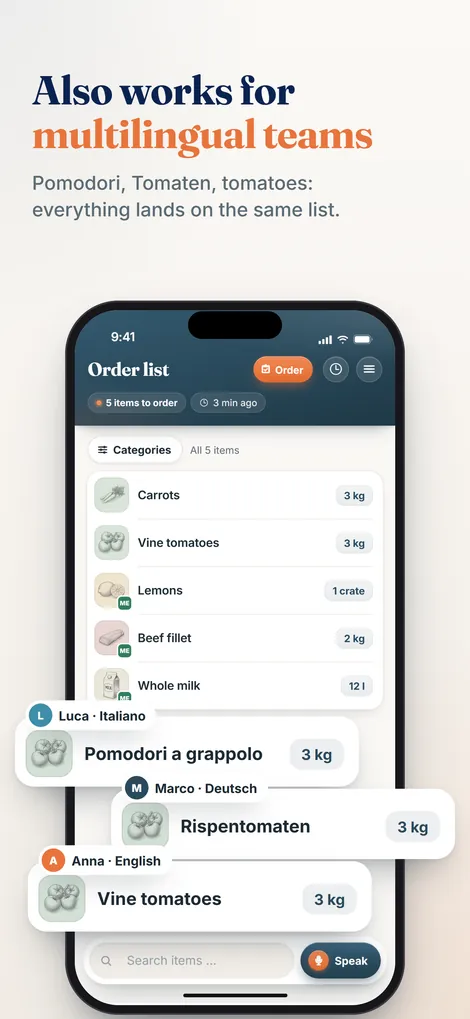
Pelican is not a POS, not a guest ordering system and not inventory accounting, and it does not place orders with your suppliers. You order the way you always do, with the rep, by phone or at the cash and carry. Pelican does not replace calls at the pass and does not see your tickets.
Frequently asked questions
What does 86 mean in a restaurant?
86 means a dish or ingredient has run out and is off the menu for now, as in "86 the salmon". Behind the bar it can also mean a guest gets cut off or asked to leave. Where the term comes from is not known for sure; there are several stories and none is proven.
What does "heard" mean in a kitchen?
"Heard" confirms that a call from the pass was heard and understood. In the noise of service it is the only way the pass knows the station has the ticket. If nobody answers, the call gets repeated.
What does "fire" mean in a restaurant kitchen?
Fire means start cooking now. When the servers say a table is ready for the next course, the pass calls something like "fire table 12" and the stations start cooking and plating that course.
What does "all day" mean in a kitchen?
All day is the total of one item across all open tickets. "Eight strip steaks all day" tells the grill how many steaks it has to cook in total right now, no matter which tables they are for.
What restaurant lingo should every new cook know?
First the safety calls "behind", "hot" and "sharp", then "heard" as confirmation, "fire", "hands", "all day" and "86". Add the terms ticket, pass, expo, mise en place and walk-in, and the names of products as your kitchen uses them.
How does kitchen lingo work in a multilingual team?
With a few fixed calls that are the same for everyone, whatever their native language. A short list at the pass helps new hires. For products the rule is one name per product, so the order comes in right as well.
Whatever is 86 goes straight on the list
Pelican collects what your team is missing in one order list, in every language in your kitchen. The chef approves, and you order the way you always do. Try it free for 30 days.
Create business and try 30 days free