 Pelican
The main types of supplier
Before you look for new suppliers, it helps to be clear about the categories. Almost every kitchen combines several of them, depending on menu and ambitions:
- Broadline foodservice wholesalers. The classic for the basics (in the UK, the likes of Bidfood or Brakes). One supplier, one order cut-off, one delivery, from butter to cleaning products. Terms depend on volume: the more you buy through one wholesaler, the better the prices and the lower the minimum order values.
- Cash and carry. You collect yourself, usually without delivery (Booker and Costco are familiar names in the UK). Strong when something runs out at short notice or you need small quantities. Too expensive and time-consuming as your only source, but worth its weight in gold as an emergency buffer.
- Specialists. Butchers, fishmongers, growers, bakers. Here you get quality and advice a broadline wholesaler doesn't offer. In return you order from several places and have to coordinate several delivery days. For any kitchen that sells on quality, they are the heart of it.
- Local producers. Farms, market gardens and growers nearby. Short distances, great freshness and a story you can tell on the menu. Availability is seasonal and quantities limited, but the relationship is often close and personal.
- Drinks wholesalers. A separate channel for wine, beer, spirits and soft drinks. Often with their own logistics, handling of returnable containers and kegs, and sometimes equipment such as glassware or dispense systems.
How to find new suppliers
Whether it is a new opening, dissatisfaction with your current wholesaler or growing price pressure: the reason varies, but the ways to find new restaurant suppliers hardly do. These work best in practice:
- Recommendations from colleagues. The fastest and most honest route. Chefs in your area know who delivers reliably and who doesn't. A call to two or three colleagues often achieves more than any amount of research.
- Trade shows and wholesaler shows. Trade shows and wholesalers' own events show range and new products all at once. You meet contacts in person and get a feel for whether the chemistry is right.
- Associations and networks. Trade associations, regional food networks and producer groups put you in touch, especially with smaller suppliers that are hard to find online.
- Take rep visits. When a sales rep knocks, a conversation is worth it even if you don't switch straight away. You get to know terms and range, and you have an alternative up your sleeve if needed.
- Approach local producers directly. Simply ask at the farm or market garden whether they can deliver. Many producers are happy to supply restaurants once quantities and rhythm are reliable.
- Arrange trial deliveries. Nothing replaces a test in real conditions. Order a modest quantity first and check quality, punctuality and how complaints are handled before moving a large share of your purchasing.
Selection criteria: what really matters
Price is the most obvious criterion and rarely the most important. A supplier who is a few pence cheaper but delivers late or stonewalls complaints costs you more in the end. These points belong on your list when comparing suppliers:
- Delivery days and order cut-off. Does the rhythm fit your order days? A supplier who comes on Tuesdays and Fridays is little use if your fresh needs arise on Mondays.
- Minimum order value. Can you reach it in normal trading without stockpiling? If not, the supplier is too big for your business.
- Price level and price stability. How stable are prices, how often do they change, are there fixed terms for your core items? Market prices for fresh produce are normal, but you should be able to follow them.
- Quality and complaint handling. Is the produce consistently right, and how does the supplier react when it isn't? Goodwill on complaints says more about a partnership than the list price.
- Reliability. Does the delivery arrive complete and on time? A missing line on Friday lunchtime tears a hole in service that no discount can fill.
- Rep contact. Do you have a fixed contact who knows your business and can be reached? A good rep thinks along with you and flags offers before you ask.
- Payment terms. What credit terms apply, is there a discount for prompt payment? That has a direct effect on your cash flow.
- Range versus specialisation. A broadline wholesaler saves effort, a specialist brings quality. For each category you decide which matters more.
Few suppliers or many? The right mix
The fundamental question behind every supplier choice: concentrate or spread. Both have their price.
Few suppliers means more volume per supplier, and therefore better terms and lower minimum orders. Effort drops: fewer order days, fewer invoices, fewer contacts. The price is dependence. If a broadline wholesaler lets you down, many categories are hit at once.
Many suppliers gives you comparability, resilience and specialist quality. You can choose the best for each category and play suppliers off against each other on terms. The price is effort: more orders, more delivery days, more coordination within the team.
For most businesses the answer lies in between: one core supplier for the basics, plus two to four specialists for the areas that define your kitchen. Review this mix once a year and renegotiate. How to pull the figures for that conversation from your order history is covered in the guide to controlling food costs.
Managing several suppliers day to day
This is exactly where the mix becomes a burden. Three suppliers means three order days, three lists and three rep visits. But needs don't arise sorted by supplier; they arrive all mixed up: the sous chef reports meat, the pastry chef dairy, someone shouts veg from the back. Without a system it ends up on different scraps of paper, and half of it is missing at the rep visit.
The solution is to collect needs centrally and only sort them by supplier at the end. Stick to that and you lose nothing and never have to retype.
How Pelican brings order to supplier chaos
That is exactly what Pelican is built for. Your team collects needs on one shared list, by voice or by typing, each in their own language. The list sorts itself by category automatically. When the rep comes, the right list is ready, and you tick off instead of retyping.
- One place for all needs. Whether meat, fish or veg, everything lands on one list instead of three notes on three doors.
- Sorted by category. During the rep visit you read out the relevant block instead of jumping back and forth between suppliers.
- Order history per supplier. What was ordered, when and from whom stays traceable. That is your basis for negotiation when you compare terms once a year.
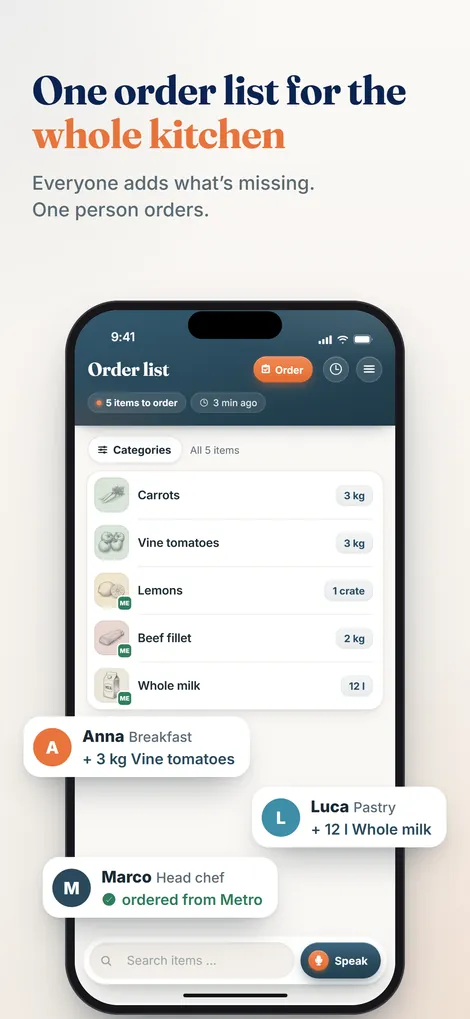
To be clear: Pelican does not find suppliers for you or negotiate prices. The price conversation stays between you and your rep. Pelican makes sure you go into that conversation prepared, with a clean list and the history behind you.
Several suppliers, one list, no retyping.
Pelican collects your kitchen's needs, sorted automatically, and records every purchase. Runs on the phones you already have. Try it free for 30 days.
Create business and try 30 days freeOnce your suppliers are in place, it is time for the process. How to prepare the rep visit and negotiate from a stronger position is covered in the guide to organising supplier orders. The whole ordering process from list to delivery is explained in the guide to the restaurant ordering process.
Restaurant supplier FAQs
Which suppliers does a restaurant need?
Most restaurants do well with a mix: a delivered wholesaler with a full range as the base, plus specialists for the areas that define your kitchen, such as a butcher, a fishmonger or a grower. A cash and carry nearby covers emergencies. How broad the mix is depends on your menu, size and ambitions.
How do I find local suppliers for my restaurant?
You find local producers through farmers' markets, producer associations, regional food networks and recommendations from colleagues. Often the direct route works best: approach a farm or market garden nearby and ask whether they supply restaurants. Many producers are happy to deliver to restaurants as long as quantities and ordering rhythm are reliable.
What is a reasonable minimum order value?
There is no universal figure; thresholds vary a lot between suppliers and regions. What matters is not the amount itself but whether the minimum order fits your ordering rhythm. If you can only reach it by ordering goods you don't need, the supplier is the wrong size for your business.
Should you change suppliers regularly?
Not for the sake of it. A well-established relationship with a reliable supplier is valuable and is not outweighed by a cheaper offer. It does make sense, though, to compare terms once a year and renegotiate. A clean order history shows you in black and white what you buy where and at what price.
How do I prepare for a rep visit?
With a finished order list sorted by category and clear quantities. Go into the meeting prepared and you are not buying on the spur of the moment, you are negotiating from a stronger position. How to organise the rep visit in practice is covered in the guide to organising supplier orders.
Part of the complete guide: Restaurant purchasing. It covers all six stages of the purchasing cycle at a glance.