 Pelican
Everything runs in your browser. Nothing is stored or sent anywhere.
What menu pricing means in a kitchen
A new dish goes on the menu and the recipe card is done: $4.20 of ingredients in every portion. Now what? Many kitchens pick the price that feels right or copy the place across the street. Either can work, but you only know whether the dish pays its way when you work backwards, from plate cost to price.
You need four terms for that:
- Plate cost What the ingredients for one portion cost at net purchase prices, after trim loss. It comes from the standardized recipe.
- Food cost percentage The share of the price before tax that goes on ingredients. Your target food cost percentage is the number you aim for.
- Pricing factor The number you multiply the plate cost by to get the price before tax. Some call it the markup factor or multiplier. It is the same math as the target percentage, turned around.
- Gross profit per plate Price before tax minus plate cost. This is the money that pays for labor, rent, energy and, in the end, profit.
The menu pricing formula
The three formulas belong together. If you prefer working with a factor, plate cost times pricing factor lands on the same price:
- Target 25 percent Factor 4. A $4.20 plate cost becomes $16.80 before tax.
- Target 30 percent Factor 3.33. $4.20 becomes $14.00 before tax.
- Target 35 percent Factor 2.86. $4.20 becomes $12.00 before tax.
Do not copy your target from the internet. It comes from your own numbers: sales, labor, rent, energy and the profit you want. The food cost calculator guide shows how to find the percentage for the whole operation. 25 to 35 percent is common, depending on the concept.
Four ways to set a price and when each one fits
In practice kitchens mix several methods. What matters is knowing which one you are using:
| Method | How it works | Strength | Limit |
|---|---|---|---|
| Target food cost | plate cost divided by the target | clear and the same for every dish | expensive dishes quickly end up overpriced |
| Pricing factor | plate cost times the factor | fast in your head and on the recipe card | same limit as the target percentage |
| Gross profit per dish | plate cost plus the dollars each plate should bring in | works for expensive items like steak or fish | you need to know what a plate has to cover |
| Market price | what guests in your area pay for similar dishes | shows whether a price can hold on the menu | says nothing about your costs, never use it alone |
A proven order: work out the minimum price with the target or the factor, look at gross profit for the expensive dishes, and compare with the market at the end. If your price is far above it, check portion and recipe before you give up on the target.
Worked examples from the kitchen
The numbers below are example values to show the math. For your kitchen only your own recipe cards and invoices count.
Chicken breast with roasted vegetables
According to the recipe card one portion of chicken breast with roasted vegetables costs $4.20 in ingredients. The kitchen aims for 30 percent food cost. For the example we assume prices include a tax of 10 percent, only so the full calculation is visible.
| Step | Calculation | Result |
|---|---|---|
| Price before tax | $4.20 divided by 0.30 | $14.00 |
| Pricing factor | 1 divided by 0.30 | 3.33 |
| With tax (example 10 percent) | $14.00 times 1.10 | $15.40 |
| Menu price | rounded up to $0.50 | $15.50 |
| Menu price before tax | $15.50 divided by 1.10 | $14.09 |
| Food cost and gross profit | $4.20 divided by $14.09, $14.09 minus $4.20 | 29.8 percent, $9.89 |
Because you round up, the food cost ends up just under the target. Rounding down to $15.00 would have meant 30.8 percent, more ingredients per dollar of sales than planned. If tax is added at the register, skip the tax rows: then $14.00 before tax is already your menu price.
Pasta and steak: same percentage or same gross profit
The same menu lists a pasta with tomato sauce and a beef steak. At 30 percent for both, it looks like this:
| Dish | Plate cost | Price before tax | Food cost | Gross profit |
|---|---|---|---|---|
| Pasta with tomato sauce | $2.10 | $7.00 | 30 percent | $4.90 |
| Beef steak at 30 percent | $9.80 | $32.67 | 30 percent | $22.87 |
| Beef steak at a set price | $9.80 | $26.00 | 37.7 percent | $16.20 |
$32.67 may not fit your menu for a steak. So the kitchen sets it at $26.00 on purpose. Food cost rises to 37.7 percent, but every steak brings in $16.20 of gross profit, more than three times the pasta. Whether that pays off depends on how often the steak sells. That is exactly what menu engineering shows.
So do not price every dish with the same percentage. Cheap dishes can sit below the target and expensive ones above it, as long as the average of your menu works and every dish leaves enough dollars on the plate.
Markup or margin: the same dollars, a different base
Two percentages get mixed up all the time, also in talks with suppliers and accountants. Both use the same gross profit but divide it by something different:
Markup
- based on the plate cost
- chicken: $9.80 divided by $4.20
- gives 233 percent
- can be well over 100 percent
Margin
- based on the price before tax
- chicken: $9.80 divided by $14.00
- gives 70 percent
- margin plus food cost percentage always add up to 100 percent
When someone says “we work with 70 percent”, ask whether they mean markup or margin. A 70 percent markup on $4.20 gives only $7.14 before tax, a food cost of almost 59 percent.
When your ingredients get more expensive
Your supplier raises the price of chicken breast, and the portion now costs $4.50 instead of $4.20. The menu price stays the same for now:
| before | after | |
|---|---|---|
| Plate cost | $4.20 | $4.50 |
| Price before tax | $14.00 | $14.00 |
| Food cost percentage | 30 percent | 32.1 percent |
| Gross profit per plate | $9.80 | $9.50 |
To get back to 30 percent you would need $15.00 before tax. You do not have to change the price right away, but you should know. Besides the price there are other levers: check portion and sides, actually hold the portion size, cost with the yield in mind and compare prices with other suppliers.
From calculated price to menu price
The calculated price is your floor. What goes on the menu is a price that fits your restaurant. Five rules help:
- Round up, not down Rounding down puts food cost above the target. After rounding, check the percentage again.
- Consistent price endings Pick one style, for example whole dollars or half dollars, and use it across the whole menu.
- Spacing within a section If all entrées sit between $14 and $32, a dish at $48 stands out. Then check portion and recipe.
- Market as a check Look at what guests in your area pay for similar dishes. It tells you whether a price can hold, but nothing about your costs.
- Price drinks separately Drinks have their own percentages and often a different tax treatment. Price them with their own targets, not the kitchen's.
How to price a menu item in six steps
From the recipe card to a price you can explain.
- Work out the plate cost. Every ingredient with quantity, yield and net purchase price on the recipe card, the total divided by the portions.
- Set your target. From your labor, rent and energy costs and the profit you want. The food cost calculator guide shows how for the whole operation.
- Calculate the price before tax. Plate cost divided by the target, or times the pricing factor. Or enter both numbers in the calculator above.
- Tax and rounding. Where prices include tax, multiply by (1 plus the tax rate), then round up to a clean menu price and check the real percentage.
- Check against gross profit and market. Does the dish leave enough dollars on the plate? Does the price fit similar dishes in your area? For expensive dishes decide by gross profit rather than percentage.
- Recalculate regularly. When suppliers change prices, when the recipe changes and at least twice a year. Note the date of the last calculation on the recipe card.
Common menu pricing mistakes
- Calculating with prices that include tax If food cost is measured against a menu price with VAT in it, it looks better than it is. Always calculate before tax.
- Mixing up markup and margin A 70 percent markup is very different from a 70 percent margin. The gap quickly costs several dollars per plate.
- Forgetting trim loss Costing at the price per pound without yield makes the portion too cheap and the price too low.
- One percentage for everything Expensive dishes end up overpriced, cheap ones underpriced. Look at gross profit per plate too.
- Only copying the competition The market price does not know your costs. If you only copy, you find out at month end that a dish earns nothing.
- Leaving prices unchanged for years Purchase prices move all the time. Without recalculating, food cost creeps up month after month and nobody notices.
Where Pelican helps, and where it does not
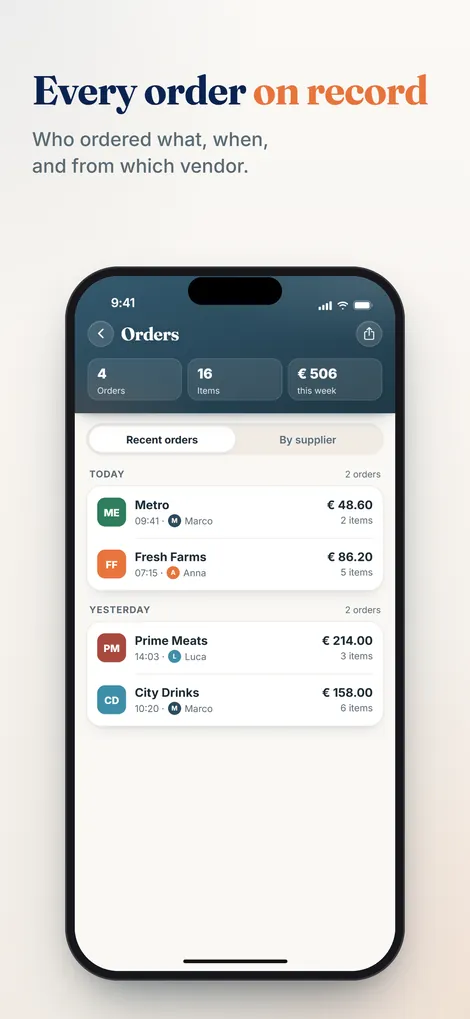
Pricing needs current purchase prices. Pelican helps with ordering: your team collects what the kitchen needs in one shared order list, by voice or typing, everyone in their own language. Duplicates are merged, and the head chef approves the list before the sales rep visits. The order history then shows what was ordered from which supplier and when, and if your team enters prices when ordering, the amounts too. That is where you notice an ingredient getting more expensive and a recipe card that needs a new calculation.
Pelican is not a POS, not a guest ordering system and not inventory bookkeeping, and it does not place orders with suppliers. You order as usual with the rep, by phone or at the cash and carry. Pelican does not cost recipes, does not calculate menu prices and does not change your menu. You work out the price with the calculator above or on your recipe card.
Frequently asked questions about menu pricing
How do you price a menu item?
Divide the plate cost by your target food cost percentage. A plate cost of $4.20 at 30 percent gives $14.00 before tax. Add tax where menu prices include it, then round up to a clean menu price.
What is the menu pricing formula?
Menu price before tax = plate cost ÷ target food cost percentage. The pricing factor is 1 divided by the target: 3.33 at 30 percent, 4 at 25 percent, 2.86 at 35 percent. Plate cost times factor gives the same price.
What food cost percentage should I use?
There is no single right number. 25 to 35 percent is common, depending on the concept. Your target follows from your labor, rent and energy costs and the profit you want.
What is the difference between markup and margin?
Both use gross profit, the price before tax minus plate cost. Markup divides it by the plate cost, margin by the price. With $4.20 plate cost and $14.00 before tax that is a 233 percent markup or a 70 percent margin.
Do you price menu items with or without tax?
You calculate before tax. Where menu prices include VAT, the tax goes on at the end. Where sales tax is added at the register, the price before tax is your menu price. Ask your accountant which rule and rate apply to you.
Can Pelican calculate menu prices?
No. Pelican is your team's shared order list. The order history shows what was ordered from which supplier and when, with prices also the amounts, so you see when an ingredient gets more expensive. You work out the menu price with the calculator above.
Notice when ingredients get more expensive
Pelican collects what your team needs in one order list, in every language spoken in your kitchen. The order history shows what was ordered from whom and when. Free for 30 days. The pricing math stays with you.
Create business and try 30 days free