 Pelican
What happens to fryer oil
Deep frying cooks food in fat at roughly 285 to 375 °F (140 to 190 °C). That builds the crust and the browning, and the food absorbs part of the fat. At the same time the oil itself changes, a little more with every hour in the fryer.
Water from the food, air and food particles trigger chemical reactions. They form polar compounds, the breakdown products inspectors measure to judge whether oil is spent. The smoke point drops, and potato and grain products fried above 347 °F (175 °C) form more acrylamide. Oil breakdown cannot be reversed, not even by filtering.
- Water Wet or frozen food brings water into the fat. That splits the fat and makes it foam.
- Air Oxygen attacks hot oil. That is why the fryer gets a cover in every break.
- Heat Above 347 °F (175 °C) polar compounds rise quickly. Frying too hot costs oil and adds acrylamide.
- Debris Crumbs, breading and salt burn in the oil and speed up breakdown. Fish and meat stress the fat more than fries.
How to tell fryer oil needs changing
There is no fixed number of days or batches. When oil needs changing depends on how much you fry and what. Food authority guidance lists these signs:
- Smoke The fat smokes at normal frying temperature, often with a bluish haze.
- Smell Sharp, acrid or burnt instead of neutral.
- Taste The cooled fat tastes bitter, scratchy, tallowy or soapy.
- Foam It foams hard and long when you drop the basket.
- Thickness The hot fat turns thicker and drains slowly off the basket.
By the time you notice these signs, the oil is usually past the limit already. That is why professional kitchens test on a schedule instead of waiting for smoke and smell.
Limits for total polar materials
Testers measure the share of polar compounds in the fat as a percentage, called TPM (total polar materials) or TPC. The point at which frying fat has to go is not the same everywhere:
| Country | Polar materials limit | Basis |
|---|---|---|
| Germany | 24 % | Recommendation of the German Society for Fat Science (DGF), applied by food inspection as the limit of fitness for consumption |
| France | 25 % (plus 14 % polymers) | Decree No. 2008-184, article 8 |
| Switzerland | 27 % | Food law, as stated by the canton of Geneva |
In the US, the UK and elsewhere, ask your local health department or food authority which value applies to you. Where no fixed value applies, 24 percent, the strictest value in this table, is a safe point to change the oil.
How to test fryer oil: three ways
There are three ways to check oil quality. Many kitchens combine them: senses every day, a measurement at set times.
| Method | What it shows | Upside | Limit |
|---|---|---|---|
| Sensory check | smoke, smell, taste, foam, thickness | free, any time | reacts late, everyone smells differently |
| Test strips | free fatty acids, color change in about 15 to 30 seconds | quick, cheap, good for daily checks | does not show polar materials in percent |
| Fryer oil tester | total polar materials in percent (TPM) | compares directly with the limit, gives a number for the log | purchase cost, care per the manufacturer |
Also check the fryer temperature regularly with a separate thermometer. A thermostat that runs 18 °F hot wears out the oil faster without anyone noticing. How to check a thermometer is covered in the guide on thermometer calibration.
Make fryer oil last longer: seven rules at the fryer
Longer oil life does not mean frying past the limit. It means slowing the breakdown. That saves oil, labor and money:
- 320 to 347 °F (160 to 175 °C) No hotter. Too cool is wrong as well: frying takes longer and the food soaks up more fat.
- Never salt over the fryer Salt and seasoning fall into the oil and speed up breakdown. Season afterwards, at the pass or in a bowl.
- Shake off crumbs, pat food dry Loose breading burns at the bottom, water makes the fat foam.
- Do not overload baskets At most one part food to ten parts fat, or the temperature drops hard, especially with frozen product.
- Keep fish and meat separate They stress the fat more and pass on flavor. If you can, keep one fryer for fries only.
- Filter and clean daily After the last service, drain the fat, filter it and clean all residue out of the fryer.
- Cover it In breaks and overnight, put the cover on against air, light, dust and water.
How much fryer oil to order each week
Oil leaves the kitchen two ways: at every full change and through daily top ups, because the food absorbs fat. Together they make your weekly need:
Example values: two fryers holding 40 lb of oil each, six operating days. In this example the tester reaches the limit after about six operating days, so each fryer is changed once a week. You top up 3 lb per fryer per day.
| Item | Calculation | Pounds per week |
|---|---|---|
| Changes | 2 changes × 40 lb | 80 lb |
| Top ups | 6 lb per day × 6 operating days | 36 lb |
| Weekly need | 80 lb + 36 lb | 116 lb |
| Order | 4 containers of 35 lb | 140 lb |
| Used oil for pickup | the change volume | 80 lb |
The 24 lb left over carry into the next week. If your supplier delivers once a week, still plan safety stock and set a reorder point, so the oil is never short on change day. The guide on safety stock and reorder point shows how.
How to dispose of used fryer oil
Used frying fat does not go down the drain. For food businesses:
- Never down the drain or in the trash Used oil does not belong in wastewater or with general waste. In the drain it clogs pipes and grease traps.
- Let it cool, then collect it Keep the fat separate in containers that close, such as drums or the empty oil containers.
- Use a collection service Specialist companies pick up used cooking oil and often supply the collection drums. Agree the pickup schedule to your volume, 80 lb a week in the example.
- Keep the receipts Hold on to pickup receipts. At an inspection they show where your used oil went.
What to record
Fryer oil belongs in your food safety checks, so in your HACCP plan. Food authority guidance recommends recording these points:
- Test result Date, fryer, reading or test strip result, initials.
- Oil change When each fryer was fully changed.
- Temperature Fryer temperature checked with the separate thermometer.
- Cleaning Filtering and cleaning the fryer, ideally on your cleaning schedule.
Your team also needs to know how to use the fryer properly. Record that training, for part time staff too.
Manage fryer oil in six steps
This turns the rules into a routine that holds on busy days too:
- Set the limit and the method. Decide at which reading the oil is changed and whether you use strips, a tester or both.
- Check the temperature before service. Thermostat at 320 to 347 °F, cross checked once a week with a separate thermometer.
- Keep the rules during service. No salting over the fryer, shake off crumbs, do not overload baskets, keep fish separate.
- Filter and clean after service. Drain the fat, filter it, clean the fryer, cover it.
- Test and log daily. Test at the same time, write the reading in the log, change fully at the limit.
- Plan oil and pickup. Work out the weekly oil need, set a reorder point and agree a pickup schedule for the used oil.
Common fryer oil mistakes
- Stretching old oil with fresh oil Never mix spent fat with fresh. Topping up is normal, but at the limit the oil is changed completely.
- Frying hotter to go faster Above 347 °F the oil breaks down faster and more acrylamide forms.
- Changing by calendar or by feel Sometimes good oil gets dumped, sometimes food is fried in spent oil for too long. Testing costs less.
- Salting over the fryer Quick to do, but every grain ends up in the oil.
- Ordering only when the last container is open Then the oil runs short exactly on change day. A reorder point prevents that.
- Pouring used oil down the drain It does not belong in wastewater, and a clogged line gets expensive.
Where Pelican helps, and where it does not
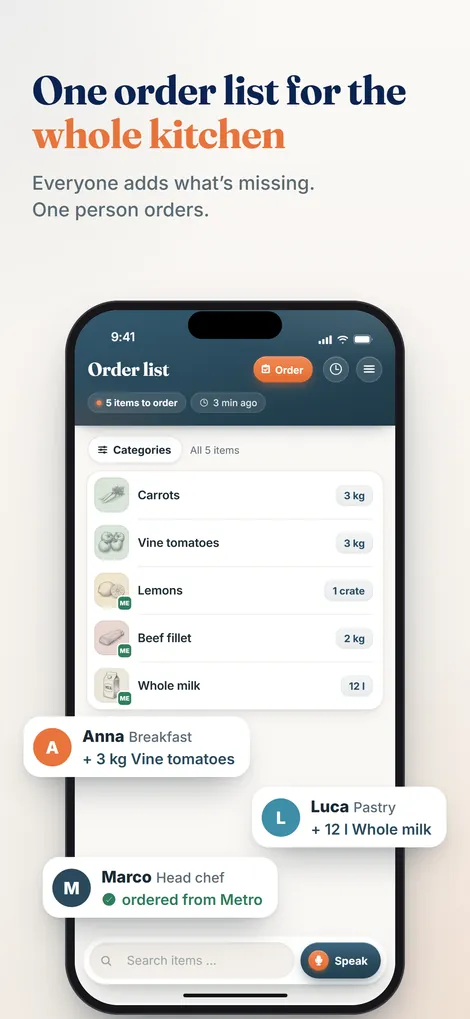
For enough oil to be there on change day, the order has to go out in time. Pelican helps with ordering: whoever sees at the test that a change is coming, or opens the second to last container, says “fryer oil” into the shared order list, by voice or typing, everyone in their own language. Duplicates are merged, and the head chef approves the list before the sales rep visits. The order history then shows how much oil was ordered from which supplier and when.
Pelican does not test oil and does not replace your log or your HACCP plan. It is not a POS, not a guest ordering system and not inventory bookkeeping, and it does not place orders with suppliers. You arrange used oil pickup directly with the collection service.
Frequently asked questions about fryer oil
How often should you change fryer oil?
There is no fixed number of days. It depends on how much you fry and what. Change the oil when testing says so: German food authorities treat frying fat above 24 percent total polar materials as no longer fit.
How do you know when fryer oil is bad?
Smoke at normal temperature, a sharp or burnt smell, a bitter or scratchy taste, heavy foaming and thick fat. Test strips or a fryer oil tester are more reliable, because the senses react late.
Can you top up fryer oil with fresh oil?
Yes, topping up is normal because the food absorbs fat. But spent fat must not be stretched with fresh oil. Once the limit is reached, change the oil completely.
What temperature should a commercial fryer be?
German food authorities recommend 320 to 347 °F (160 to 175 °C). Hotter breaks the oil down faster and forms more acrylamide in potato and grain products. Cooler makes food soak up more fat.
How do restaurants dispose of used fryer oil?
Not down the drain and not in the trash. Let it cool, collect it in containers that close and have a collection service pick it up, which often supplies the drums too. Keep the pickup receipts.
Can Pelican test fryer oil?
No. Pelican is your team's shared order list. Whoever sees oil running low adds it by voice, and the order history shows how much oil was ordered each week. Testing and recording stay with the kitchen.
Fryer oil on the list in time
Pelican collects what your team needs in one order list, in every language your kitchen speaks. The order history shows what was ordered from whom and when. Free for 30 days. Testing stays with you.
Create business and try 30 days free